
Seeing as it’s the spooky time of the year, I thought it’d be nice to revisit the Luigi’s Mansion series this time of year among other spooky game franchises and compare all of these games to one another.
Luigi’s Mansion released back in September of 2001 as a launch title for Nintendo’s newest console at the time, the Gamecube. A demo was shown at the Nintendo Space World 2000 in order to show off the graphical capabilities of the Gamecube before being turned into a real game afterwards. The game received mostly positive reviews, but some also criticized it for not being a more traditional Mario adventure in addition to its short length.
Luigi’s Mansion

This game sees Luigi as the protagonist for the first time in the series (the first time since Mario is Missing, but Nintendo doesn’t count that.) The plot revolves around Luigi winning a mansion in a contest he never entered. He is supposed to meet Mario at the mansion he won but Mario is nowhere to be found. Luigi enters the mansion and is attacked by a ghost before being saved a tiny man in a lab coat with a vacuum who introduces himself as Professor E. Gadd. E. Gadd explains to Luigi that the mansion came out of nowhere just a few days prior to him showing up and that he saw Mario enter the mansion but never come out. He gives Luigi the “Poltergust 3000” (the vacuum cleaner he used earlier) and a communication device known as the “Game Boy Horror.”
Gameplay takes place inside the titular mansion over the course of four stages. Luigi can go back and forth between E. Gadd’s lab and the mansion in between stages. Despite taking place over four stages, the mansion is an interconnected world with the stages only blocking off specific parts of the mansion until you progress further in the game. By the end of the game, the entire mansion can be explored by the player. The main enemies players will have to deal with are ghosts, and players have to suck up these ghosts in order to defeat them. Players must use Luigi’s flashlight to stun the ghosts, and for a short window, they’ll be able to suck up the ghosts. The ghosts will try to fight the player by flying away, which means the player will have to use the sticks on the Gamecube controller to pull the ghost back in the opposite direction its flying. The two sticks on the Gamecube controller make this incredibly satisfying. The player will have to continue sucking up the ghost until its health depletes completely. If the ghost escapes, then Luigi will be left open to attack. If Luigi’s health reaches zero, then its game over. When the player clears a room full of ghosts, the music will change, replacing the normal eerie theme of the game to Luigi cheerfully whistling the main theme. There are also elemental medals. These medals can be found in the mansion and once obtained, give Luigi the ability to suck up elemental spirits to use. Fire can melt ice, ice can freeze water, and water can extinguish fire. The Game Boy Horror can also be used as a map of the mansion. The map displays rooms the player has explored before, room that have yet to be explored, doors, and locked doors. You can even use the Game Boy Horror to scan certain objects and see Luigi’s commentary.

There are also “Portrait Ghosts,” ghosts that previously resided in Professor E. Gadd’s paintings but have managed to escape. These ghosts are different from other ghosts as they’re stronger and sport more unique designs and small puzzles that the player must solve so that way they can defeat them. An example of this is a portrait ghost themed after a butler which wanders through the halls with a candle. The player must light the candle on fire, frightening the butler to run into another room so he can douse the flame. Once the flame is doused, the player is able to suck him up. Another example is the very first portrait ghost players will encounter, Neville. Neville will taunt the player at first for not being able to suck him up as he’ll turn invisible anytime the player flashes their flashlight on him. The player will need turn their flashlight off or face the opposite direction until he yawns. Once he yawns, the player can quickly flash their light at him and suck him up. Boos will also appear later in the game and there’s a total of 50 of them to find and capture. They’re hidden throughout the mansion so the player will have to find them, which adds another fun little side activity to do in order to familiarize yourself with the mansion better. The ways the Boos are captured are also mechanically different than other ghosts, as the player needs to play a game of Hide and Seek throughout the mansion to find them. Upon finding them, all the player has to do is suck them up. If the Boo escapes the player’s vacuum, then it will leave to another room, which will force the player to give chase to them. Luckily, the Game Boy Horror is equipped to help find these Boos. The Game Boy Horror will start beeping whenever a spherical object is present, though sometimes Boos can leave decoys such as balls or even bombs, so players will have to be careful when searching for them. There are also boss ghosts which are featured at the end of each stage and are just slightly more cinematic portrait ghosts.
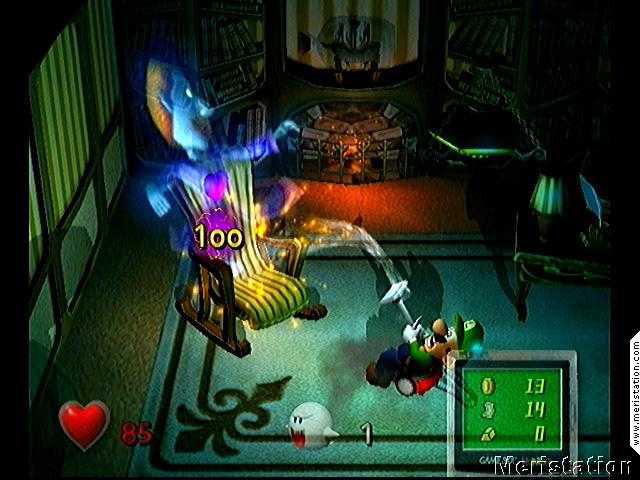
Treasure is also a big part of the game. You can get treasure from capturing ghosts, finding chests, or from shaking basic furniture. The more treasure you collect throughout the game, the better the rank you’ll get at the end of the game. Upon completing the game, you can unlock the “Hidden Mansion” which is essentially the game’s hard mode. All it does is double the damage ghosts do to you while also doubling the damage you do to them. But that’s only in the American version if the game, as the PAL version got a better version of this mode. There’s also the gallery, which has all of the portrait ghosts on display in a hall underneath E. Gadd’s lab, which is nice to look at every once in a while.
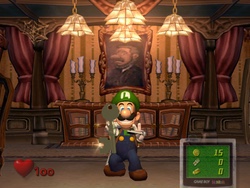
There is also the 2018 Remake of the game for the Nintendo 3Ds. The 3Ds version adds 2 player co-op (don’t play the game like this, it runs at 2 frames a second), a new design for the gallery, a boss rush mode, a map display on the bottom screen, and amiibo support alongside graphical adjustments. The game also improves on the Hidden Mansion mode for all versions of the game in addition to adding a feature that lets the player use the Strobulb from the game’s 2013 sequel. A lot of people say that this game should’ve released on the Switch, and I agree, it should’ve. But a common defense among this game being on the 3Ds was that the Gamecube at some point was supposed to use stereoscopic 3D but was scrapped due to 3D Televisions not being widespread at the time in addition to making the price of the Gamecube a bit costly for some people. But yeah, this version is fine, but the Gamecube version feels and plays a lot nicer than the 3Ds one, though this isn’t a bad remake at all and its entirely subjective as to which one you prefer. I personally don’t think the 3Ds having 3D though is a good enough justification for the game being on the system though.
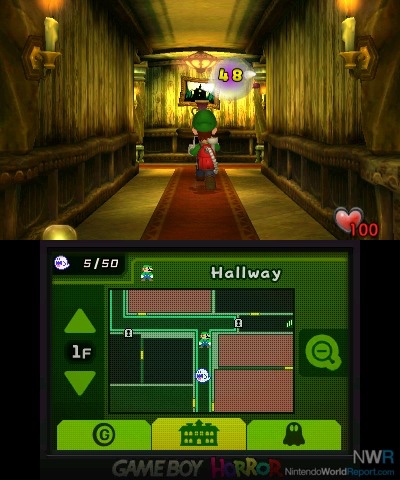
Out of the other games in the series though, this is probably my personal favorite. The atmosphere is creepy, the sound design is great, and the graphics still hold up today. Plus, I think the short run time makes it incredibly replayable, as the game can be beat in under 10 hours. I also forgot to mention how great the sound design in this game is. Play this game.
Luigi’s Mansion 2/Dark Moon

I’ve already talked about the Year of Luigi before and that isn’t the last time I’m going to talk about, but I’ll just recap it here. The Year of Luigi was a marketing plan that Nintendo did back in 2013. The year mainly focused on giving the spotlight to Luigi with tons of games, merch, and more. Unfortunately, the entire event flopped, losing Nintendo tons of money in the process. The reason the event flopped can be pinned on the low sales of the Wii U. Among other Luigi-based products to come out this year, Luigi’s Mansion 2 or “Luigi’s Mansion Dark Moon” if you live in America released and is a sequel to the original Luigi’s Mansion which was released on the Gamecube twelve years earlier. For the sake of this section though, I’m just going to call it Luigi’s Mansion 2 as that’s the title it has in Japan, Australia, and Europe.
The story this time around revolves around King Boo shattering the Dark Moon. All of the pacifist ghosts suddenly go berserk because of this. Professor E. Gadd then contacts the only Ghostbuster who still has his contact number, Luigi. Luigi now has to traverse through 5 mansions that all reside in Evershade valley and collect the broke fragments of the Dark Moon.

This time around Luigi is equipped with the Poltergust 5000, Dual Scream, and Dark-Light Device. Rather than being set in one location that opens up as the story progresses, the game decides to take on a mission structure. Each mansion has its own mission-based levels. There’s “Gloomy Manor” which is a standard haunted mansion, “Haunted Towers” which are two greenhouse towers connected to one another, “Old Clockworks” which is the ruins of some old clockworks in the desert, “Secret Mine” which is an abandoned mine located in a snowy tundra, and “Treacherous Mansion” which is the final mansion. Each mansion has five missions and one boss battle except for Secret Mine which only has 3 missions and one boss. These missions will range from doing things such as retrieving an item, accessing a specific room, defeating a type of ghost, or escorting a toad. Upon completing the mission, the player will be ranked based on their performance in the mission.
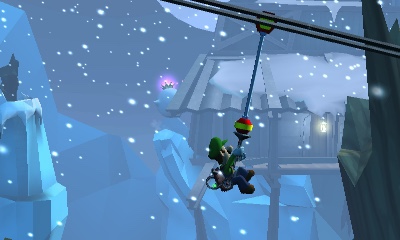
This time around, flashing your flashlight on ghosts isn’t enough to stun them. Instead, you must charge your strobulb with the A button. Once charged, you can flash at the ghosts, stunning them. The longer you charge the strobulb, the more area it will cover allowing you to suck up more ghosts. The Dark-Light device also helps Luigi reveal invisible items and doors. Motion controls are also used during certain sections in the game. Sometimes the controls work, and other times they can be frustrating. The bosses in this game have pretty unique concepts such as burning through giant webs in order to defeat a giant spider possessed by a ghost. Unfortunately, the Portrait ghosts are done away with in this entry and are instead replaced with ghosts known as “Possessors” and their designs are basically all the same with the only difference being the number of horns on their heads. There’s also the Polterpup which is an incredibly adorable ghost dog that forces the player to play a game of hide and seek in the mansion to find him whenever he appears. Boos also make a return once again and they can be found by using the Dark-Light Device in each mission. Gems are also scattered throughout the mansion and can be collected, giving completionists extra incentive to go back to previous levels to collect them all.

There is also the “Scarescraper” which is the game’s multiplayer mode. Up to four players can participate and they all play as different colored Luigis as they complete tasks in the mansion. There are multiple modes players can choose to play. Hunter Mode sees the team of Luigis try to catch all the ghosts on a floor to progress to the next one under a time limit. Rush Mode will see players try to find the exit before time runs out. Polterpup mode has players track down Polterpup under a time limit. And Surprise Mode is a mode that forces the players to play through all three previously mentioned game modes in a randomized order. There are also ghosts exclusive to the Scarescraper to catch as well as boss ghosts and upgrades exclusive to this mode. Different difficulties can be selected for this mode including an endless mode.

Luigi’s Mansion 2 is still a pretty good game, but it doesn’t come close to the original at all. The game doesn’t have as creepy of an atmosphere as the original and the mission-based level structure isn’t as fun as having one cohesive world to explore. I can see why they changed to this gameplay style, since the 3Ds is a portable device meant to be played in small bursts. So naturally you’d want to have levels that can be played in small bursts as well, but it still isn’t as fun as the original. I liked the change in artstyle though, with a lot of objects having more jagged edges to them. The loss of portrait ghosts also hurts this game to a degree, as most of the ghosts look identical to one another with small and minor changes to their appearances. But I still had a relatively fun time with the game, even if I prefer the original.
Luigi’s Mansion Arcade

I don’t even think I should count this as a game, but since there’s so little entries in this series, I figured I would anyways even though. In general, there isn’t much to say about this game. I walked into a Dave & Buster’s one day with a friend and we saw this machine there, so we decided to play it. This version of the game has no story to cover and is basically just an on-rails light gun shooter version of Luigi’s Mansion 2. The arcade cabinet has the nozzle from the Poltergust 5000 that players control and aim at the screen with. Ghosts will appear in waves and will require players to stun them with a button and pull on the trigger to suck the ghosts in. There are also stun bombs the player can throw in order to stun every ghost on screen and clear large waves of ghosts. Coins can also be sucked in to increase the player’s score. But yeah, it’s pretty fun, especially with friends. This game is a lot of fun with friends, so if you have any, go play it with them if you ever find one.
Luigi’s Mansion 3

The final entry of the Luigi’s Mansion series as of this writing and is the long-awaited sequel to Hotel Mario. This game’s initial reveal can actually be traced back to the trailer that revealed Simon and Richter Belmont for Super Smash Bros. Ultimate. The trailer shows Luigi running from various monsters from the Castlevania series with a Poltergust that looked and functioned a bit different from the other Poltergusts we’ve seen him use up until that point. Luigi’s Mansion 3 was officially revealed a month after that trailer dropped.
The story this time around is that Luigi, Mario, Peach, and Toad have all been invited to stay at a hotel by name of “The Last Resort.” After finally settling in, Luigi wakes up to find the hotel’s appearance has changed to that of a haunted building in addition to his friends going missing. He encounters the owner of this fine establishemtn, Hellen Gravely, who reveals that this entire hotel was part of a trap planned by King Boo. She explains that she’s freed him from the portrait E. Gadd trapped him in and that he wants to exact revenge on Luigi by imprisoning him and his friends in portraits, much like how he and E. Gadd did in the past. Luigi manages to escape via a laundry chute. Luigi then follows his pet Polterpup around the hotel, where he finds the Poltergust G-00. He follows Polterpup some more until he finds E. Gadd trapped in a portrait. Luigi finds the returning Dark-Light Device and uses it to free E. Gadd. E. Gadd sets up a portable lab in the garage and explains to Luigi how he was also invited to the mansion and was subsequently captured in addition to Hellen stealing his ghost collection and using them to staff the hotel. And with the help of two brand new gadgets, the Virtual Boo and Gooigi, Luigi sets off to find the missing elevator buttons in order to reach the top floor and save his friends.

This game goes back to the original formula the first Luigi’s Mansion game had, ditching the mission-based system from 2 and making the world interconnected. Players will explore each floor of the hotel to find the missing elevator buttons which are held by various ghosts that the player will need to defeat most of the time. There are seventeen floors in total, with each floor having a different theme of some kind. For example, one floor is themed after a pirate ship while another is themed after a disco dance floor. Like the original Luigi’s Mansion, the game’s world is largely interconnected but is restricted at the start, though it becomes more and more open the more the player progresses through the game. A big new addition to the series though is the introduction of Gooigi. Gooigi originally appeared in the 3Ds remake of Luigi’s Mansion as the character the second player plays as while playing co-op. Gooigi invincible when it comes to spikes and can squeeze through narrow gaps like vents and grills. Unfortunately, water and fire will melt Gooigi if he comes into contact with either of the two in addition to having significantly less health than Luigi (Luigi has 100 hearts while Gooigi only has 30.) Gooigi is mostly used to solve puzzles and explore areas Luigi can’t normally access. With the addition of Gooigi though, the entire game can be played with two players working together.
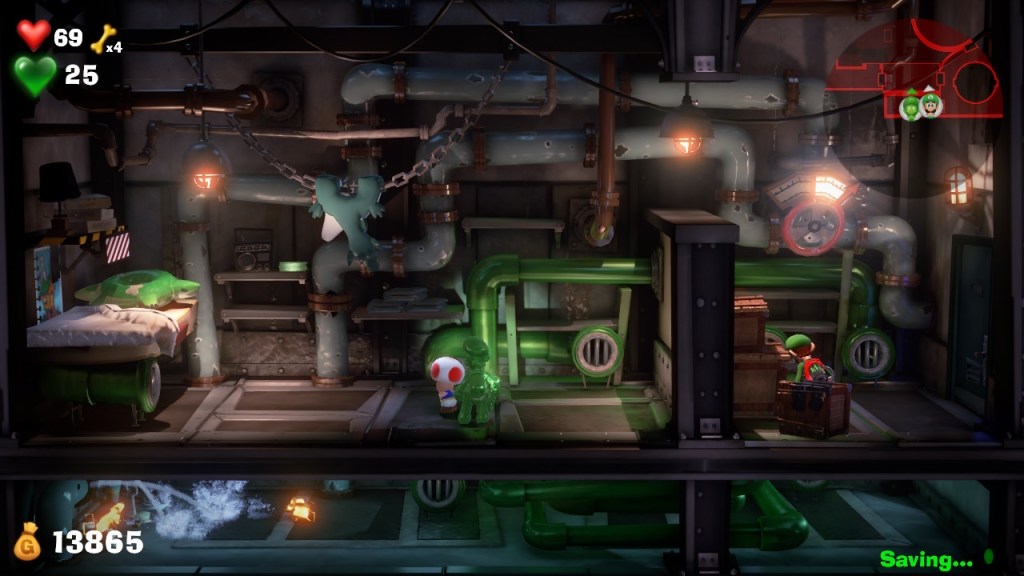
Luigi also has two new additions to his moveset. The burst pushes Luigi up into the air, launching a gust of air underneath him that can blow objects and enemies away in the process. This move can also be used a dodge of sorts against specific enemy attacks. There’s also the Suction Shoot, which launches a plunger. When the plunger attaches to an object or enemy, Luigi can use the Poltergust to grab the attached object and either pull or slam the object depending on what it is. This leads into another new mechanic in the game, slamming. When catching ghosts now, Luigi can slam the ghosts into the ground multiple times to take away huge chunks of the ghost’s health. Portrait ghosts also return this time around and they present some of the most fun and unique boss battles the series has seen yet. Boos also return and function similarly to how they did in Luigi’s Mansion 2. Gems also return from Luigi’s Mansion 2 and there is a set of gems for each floor that are hidden. The Polterpup missions from Luigi’s Mansion 2 are also brought back in the form of the Polterkitty. Like the Polterpup in Luigi’s Mansion 2, the Polterkitty can be really annoying as it will steal the doorknob you just got and run off with it, requiring the player to look around the floor and try to find the Polterkitty. All the Polterkitty really does is pad out the game’s run time, and this is a lot more noticeable in this game then it was in Luigi’s Mansion 2.

There’s also the returning Scarescraper from Luigi’s Mansion 2 which can now be played with up to eight players either locally or online. The Scarescraper functions similarly to how it does in Luigi’s Mansion 2. There are 6 different objectives players can get while playing the Scarescraper. There are objectives like capturing every ghost on a floor, defeating all the crows, rescuing various toads, collecting money, capturing rare ghosts, or defeat the boss. Also, like Luigi’s Mansion 2, there are difficulty options, a timer, items that appear and traps that are laid out on each floor. DLC was also released for this mode which gives players optional costumes and floor themes based off of the various floor themes found in the main game. Along with additional costumes and floor themes, new rare ghosts are included alongside the DLC. If you buy all of the DLC, you will also receive a custom flashlight that you can equip in the main game. The flashlight displays the Polterpup’s face when shined on walls or other objects.
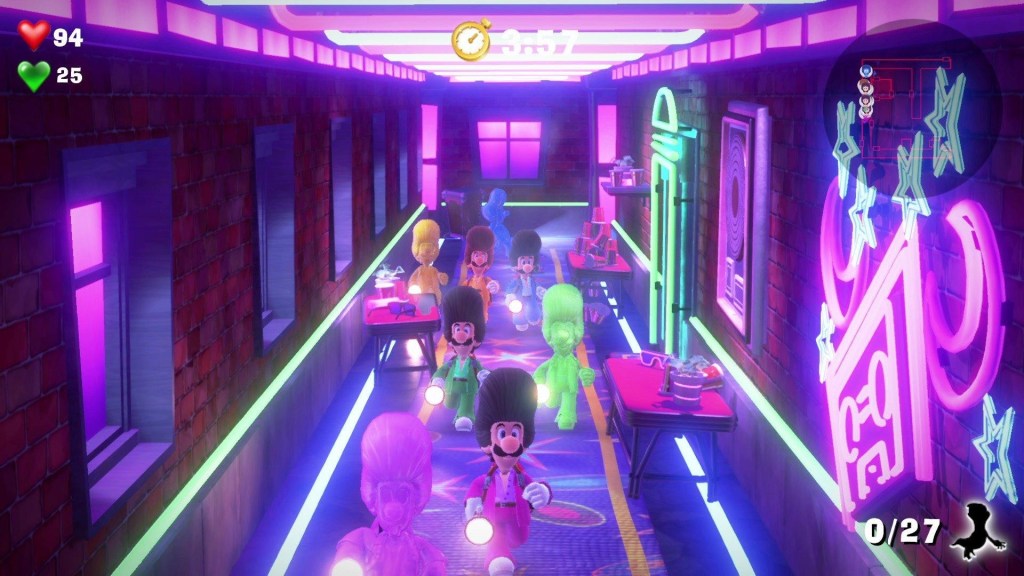
There is also a brand-new addition to the series in the form of the ScreamPark, which is a competitive team mode. There are two teams, team Luigi and team Gooigi. There are three different types of matches players can participate in. “Ghost Hunt” has the two teams try to score more points than the other by catching ghosts. “Canon Barrage” which sees the two teams securing cannonballs to load into canons and firing them at targets to get more points than the opposing team. And then there’s “Coin Floating” which has the two teams trying to collect coins while floating around on rafts while avoiding mines. These are nice distractions, but that’s all they really are, a fun set of minigames if you’re ever bored.

While I still have the most fun with the first game, this game is really fun as well. It has probably some of the best animation from a Mario game as every cutscene looks like it came straight out of a legitimate cartoon. The lighting is also amazing in this game. It may not give off the same kind of atmosphere the first game gave off, but it didn’t really feel like this game was trying to capture that atmosphere. It felt like it was instead trying to develop its own atmosphere, which works for this game. The characters are incredibly expressive and graphically looks amazing on the Switch. I played this entire game once alone and again with a friend, and I have to say that this experience is a lot better with a friend. The game is still enjoyable when playing alone, but I’d say if you want to get the most out of this game, then you should play with a friend as it feels like this game was meant to be played with two people due to the sheer number of puzzles focusing on Luigi and Gooigi working together as a team.
But that pretty much covers the entire series. In the end though, while the first game is a classic, I’d say Luigi’s Mansion 3 would probably last you the longest with its plethora of multiplayer and side content. Though you should still try to play the original Luigi’s Mansion, whether it be the original release on Gamecube or the 3Ds remake. The original Luigi’s Mansion is literally a modern arcade game, challenging players to come back again and again to get more and more treasure, get better at defeating bosses, and perfect your runs to beat the game faster and faster. Luigi’s Mansion 2 took a step forward in advancing the series but also took two steps back. And Luigi’s Mansion 3 brings in the best elements from both games and delivers a great co-op experience while moving the series forward in a more positive way. These games also helped make Luigi a character that stands out from Mario, because before the first Luigi’s Mansion game, he was just a palette swap of Mario. Though If you can, you should play at least one of these games at some point in your life. And if you already have, then Halloween is the perfect time of year to replay them.

Luigi’s Mansion was reviewed on the Gamecube and the Nintendo 3Ds.
Luigi’s Mansion 2/Dark Moon was reviewed on the Nintendo 3Ds.
Luigi’s Mansion Arcade was reviewed at a Dave & Busters.
Luigi’s Mansion 3 was reviewed on the Nintendo Switch.
 The Squeeble Site