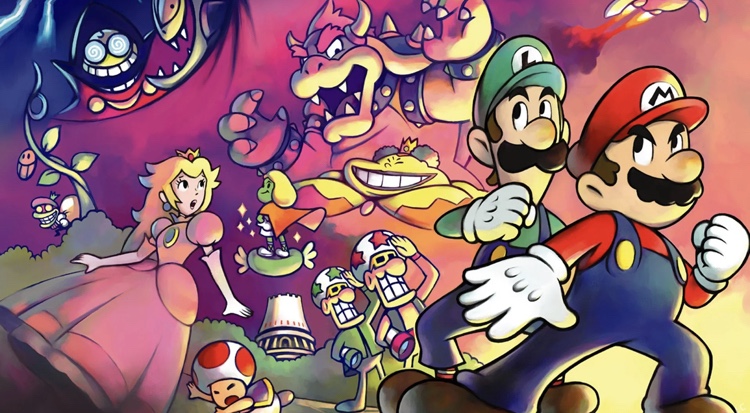
The Mario & Luigi franchise is now another one of those extinct Nintendo franchises, but was going strong for quite a long time, about a good 16 years to be exact. The series was developed by the now unfortunately defunct AlphaDream, which went Bankrupt sometime around 2019 (Which will be talked about later).
Summary
The Mario & Luigi series consists of RPG titles that follow the brothers of the same name. Each title introduces a new gimmick of sorts that becomes the identity of that title. The series had its first entry back in 2003 with “Mario & Luigi Superstar Saga.” That’s kind of it; the stories are loosely connected but you don’t have to play one game to understand another.
Initial Creation
The series was developed by, as mentioned before, AlphaDream, which was founded in 2000 and consisted of former Squaresoft (Now known as Square Enix) employees. Some of these employees had previously worked on the original “Super Mario RPG” on the SNES. AlphaDream made a few smaller games of their own before finally creating Mario & Luigi: Superstar Saga in 2003. Most notably among these smaller titles though was a small game known as “Tomato Adventure,” which shares quite a bit in common with the Mario & Luigi titles.
Mario & Luigi: Superstar Saga/Superstar Saga + Bowser’s Minions

The first entry in the Mario & Luigi series and by far the simplest one to date. The story is quite simple, Princess Peach’s voice is stolen by two new villains: Cackletta and her underling Fawful (more on him later) who both hail from the “Beanbean Kingdom.” Mario and Luigi rush to the castle only to find Bowser there. Bowser reveals that he was about to kidnap Peach but decides not to due to Peach’s voice being replaced with explosive text. The bros decide to board Bowser’s airship and fly to Beanbean Kingdom. They are then attacked by Fawful mid-flight which leads to the bros being separated from Bowser after the airship crashes on the Mushroom Kingdom side of the border between the two kingdoms. That is the extent of the story as the bros go and visit various different areas throughout the Beanbean Kingdom to try and find a way to restore Peach’s voice.

Like the story, the gameplay is also pretty simple. The game is a turn-based RPG, and each brother is controlled with one button, Mario is controlled with ‘A’ while Luigi is controlled with ‘B’. The bros follow this button scheme not only in combat, but also in the overworld. In the overworld, Mario and Luigi start with only having a single action and that is their ability to jump. As the story progresses though, Mario and Luigi will encounter other duos similar to them who teach them a variety of different techniques to use in the overworld. Both of the brother’s actions differ from one another though. For instance, when the bros get hammers, Mario can use the hammer to bash objects in the overworld while Luigi uses his hammer to squash Mario, making him smaller, allowing him to enter smaller areas the player couldn’t access before. This also applies to various other abilities the bros will learn later in the story. In addition to learning these abilities and being able to use them in the overworld, they’ll also be able to use them in battle. In battle, Mario and Luigi will only have the action to attack by jumping at first, but later gain access to the ability to use hammers. Different enemies require different kinds of attacks as an enemy with spikes on them can’t be jumped on otherwise Mario or Luigi will take damage. Because of this, players may have to use the hammer to attack these enemies. Some enemies can even fly, which means the player won’t be able to hit them with their hammers and must attack by jumping on them. Similar to the Paper Mario series, players can also time their actions while the bros are attacking to perform stronger variations of those moves. If you time your button press correctly while jumping, you could potentially earn the chance to perform a second jump during the attack. When one of the bros start charging up their hammer, if timed correctly, the damage of the attack with the hammer can be increased. When the time comes for the enemy to attack, players will also be given the opportunity to try and dodge the enemy’s attack. The enemy will also give off a hint as to which bro they’ll attack, which requires the player to be paying close attention as to which character they’re targeting. There’s also “Bros. Attacks” which require ‘BP’ to perform. These attacks require Mario and Luigi to cooperate with one another in order to perform a strong attack. These attacks will require the player to use both the A and B button when prompted due to both Mario and Luigi being involved in the attack. There may also be points in the story where the bros are separated from one another, which disables certain abilities the player can use in both the overworld as well as in combat. Upon completing a battle, the bros are rewarded with Exp. Gaining enough exp allows the bros to level up and when leveling up, the player can choose which stat they want to raise. Upon choosing which stat they want raised, they’ll spin a roulette wheel, the number the wheel lands on affects how much the stat will raise. This feature allows for a way to customize the game and have it tailored to how you want to play it. Though investing exclusively in the attack stat makes the game a cakewalk, and that goes for all future games as well. Items can also be used in battle with some restoring HP, some restoring BP, some can temporarily increase stats, or even revive a fallen bro. Gear can also be equipped and can give the bros certain abilities and raise stats. Badges can also be equipped to add extra effects for when in battle. Badges make an appearance in every game afterwards except for Paper Jam.
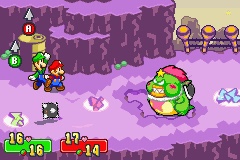
Beans can also be found throughout the overworld and can be blended into various types of coffees. These coffees can permanently raise the stats of the brother who drinks it. This all can be done at a café known as the “Starbean Café” which is run by none other than Professor E. Gadd, the same professor from the “Luigi’s Mansion” series. This is slightly off-topic, but I just thought I’d mention here while on the topic of the café. This café isn’t exactly interesting because of what it is, but rather because of what it could’ve been. The café was originally not only supposed to feature Professor E. Gadd, but also other Nintendo characters such as Wario, Fox McCloud, Captain Olimar, Samus, Link, and even the Excitbike Rider. There are even unused sprites for each of these characters, and their exclusion is made even stranger since you even get items based on these characters such as the Tri-Force. But that basically covers most of the gameplay (unless we want to cover the tutorial where Toad sees Mario naked.)

Exploration is really fun in this game. The Beanbean Kingdom is very vibrant and full of color and looks different enough from the Mushroom Kingdom to be a breath of fresh air considering most Mario games take place there. Every location is even named after a synonym for laughter such as “Hoohoo Mountain,” “Chucklehuck Woods,” “Teehee Valley,” and so much more. Each area also looks visually distinct from another and features a bit of platforming to offer a bit of level design. Compared to later entries in the series, there isn’t as much to do when it comes to exploration aside from collecting all of the beans. There is a part in the game where the player has to go around and explore the many locations they’ve visited in the past, which helps add to that feeling of this being a large and interconnected world. When you first cross the border and head out to Hoohoo Mountain, there’s a telescope there and when looking through it, it shows just how big the Beanbean Kingdom really is and how you’ve only experienced a small chunk of it at that point in the game. The game is fairly linear throughout the story, but as you progress a lot more locations open up thanks to the abilities you get throughout the story, so that definitely helps add to exploration and replayability. There are some fun platforming challenges in certain areas, unique locations, and interesting locales, but that’s really all there is to the exploration in this game.

The characters featured in this game, both new and old, are also really well written and greatly entertaining. Prince Peasley is a pretty cool character, Fawful is delightfully entertaining with his broken English and strange metaphors, Popple is a minor side antagonist but manages to be funny each time he makes an appearance, Bowser is also really fun in the few appearances he makes in the game. And Luigi is still Luigi, meaning he’s great.
There’s also the remake that released in 2017 for the Nintendo 3Ds, titled “Mario & Luigi Superstar Saga + Bowser’s Minions.” The main new addition to this remake (aside from it being a remake in general) is the new “Bowser’s Minions” side mode. This story follows a lone Goomba who sets off to rescue Bowser while assembling an army to help him in his efforts. This mode mainly consists of assembling a squad and sending them out to fight a few waves of enemies per mission. Your squad attacks automatically which doesn’t really make it that fun or really as engaging as the main game. This game follows the “weakness triangle” style of gameplay. Melee minions can beat ranged minions, ranged minions can beat flying minions, and flying minions can beat melee minions. You can sometimes interact with the squad to help save them from certain enemy attacks or to have them execute attacks, but only when the game prompts you to. Most of the enjoyment I personally got out of this mode was simply assembling my squad and sending them out into battle. To me though, actually watching the battle unfold was boring. This mode does have an interesting story though with how it directly foreshadows the third entry in the series (Bowser’s Inside Story) in a clever way. Though this interesting foreshadowing can’t really justify sitting through a boring side-story. The remake was also criticized by fans for taking the charm away from the original game in terms of the art style. While I partially can agree with this, I still think this remake looks beautiful, especially with the redone overworld. The new sprites of certain characters don’t look nearly as good as the original sprites and these new sprites do manage to affect the more cartoonish humor and tone at times with how expressionless the characters can look at times.
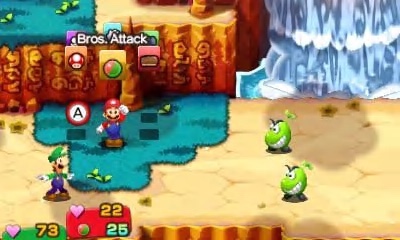
Yoko Shimomura also does an amazing job with the music for this game. There’s so many great and memorable tracks such as “Come on,” “Cackletta’s Theme,” “Welcome to Beanbean Kingdom,” “Star ‘Stache Smash,” “Teehee Valley,” “The Last Cackletta,” and many more amazing tracks. The remake also remixes a lot of these tracks and even adds a few new ones to boot. Charles Martinet still voices Mario and Luigi in these games, and he does a great job not just in this game, but in the entire series at just speaking random gibberish as the two brothers. The sound design for this game, both the original and remake, is fantastic, and that stays true for future entries.
This is a pretty great first entry and while it may be the simplest when compared to others, it has the most charm in my opinion. The cartoonish humor and visuals were like eye candy in the original and the remake presents its own visually appealing art style when it comes to the environments. Music is top notch as well the writing. And the story, while simple, is still pretty engaging compared to most other Mario stories that involve Peach getting kidnapped. If you wanted to get into the series, then I would recommend starting with this game, though starting with any of the others is still perfectly fine.
Mario & Luigi: Partners in Time
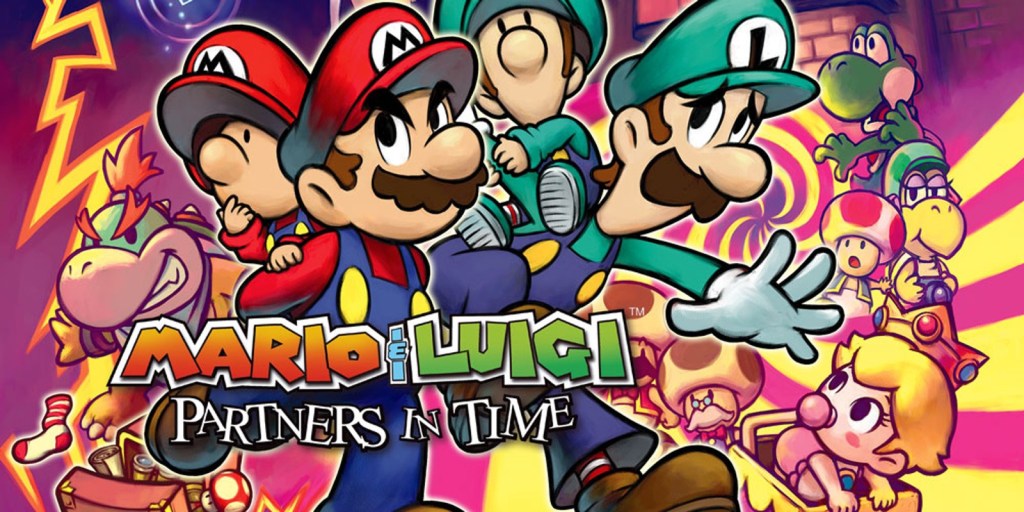
It seems pretty strange to follow up the first entry of a newly established series with a sequel that involves time-traveling. But that’s what Partners in Time is about, time travel. (Fun fact: on the back of the physical case of Partner’s in time, the title is printed wrong and says, “Partners in Crime.”) This entry, as mentioned before, focuses on time travel. This idea came from the new handheld console that it was being developed for: the Nintendo DS. The idea came from the four buttons the DS had, which gave the developers the idea to have the player control four characters this time around. The story for this game is that Professor E. Gadd has invented a time machine that is run by an item known as the “Cobalt Star.” Princess Peach then enters the time machine to travel to the past but fails to return, with the time machine instead bringing a member of an alien species known as the “Shroobs” back with it. When Mario defeats the alien, a hole appears in the castle which is actually a gateway to the past. Mario and Luigi jump into the hole and travel to the past, where they meet themselves in the past, specifically baby versions of themselves.
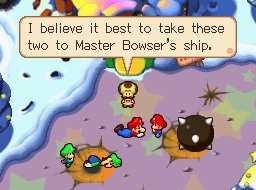
This is where the new characters come into play. Mario still uses the A button and Luigi still uses the B button, but thanks to the DS’ two new buttons, Baby Mario can be controlled with the X button and Baby Luigi can be controlled with the Y button. Combat works the same as it did in Superstar Saga, though now the BP system has been removed. Because of this, this game could be considered the most broken entry in the series. Instead, the Bros. Attacks are purchased and treated as items, and you can purchase as many as you want with your only limitations being the number of coins you have on you and the item capacity. Some of these Bros. Attacks can also go on for a near infinite amount of time, given that you have the skills to keep the move going on forever that is. Because of this, depending on your skills, boss fights can be a joke at times. Attacking in general can be a bit more confusing at first considering the main adult bros’ attacks are now compounded by the baby bros’ attacks. For instance, now the hammers can only be used exclusively by the baby bros rather than the adult bros. The baby bros are a lot more crucial to battle than the adult bros are since if the babies are taken out, then that can remove a basic form attacking for the adult bros, hammers. Though, like the first game, the combat is pretty easy to get used to in short amount of time.

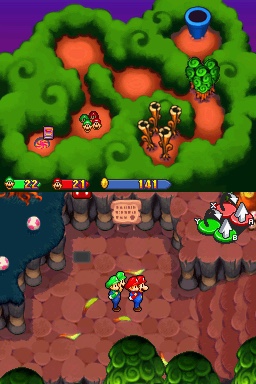
Gameplay in the overworld is also the same, with the main difference being the addition of an extra screen as well as two more playable characters. Most of the game takes place on the bottom screen, with a map being displayed on the top screen. Whenever the babies separate from the adult bros though, the babies appear on the top screen and are controlled up there while the adult bros are controlled on the bottom screen when separated from the babies. The two screens also apply to battle, as the battles take place on the bottom screen, but certain attacks and actions can happen on the top screen. Overworld gameplay though is still relatively the same as the first.

Overworld exploration is also the same as the first for the most part, but this time there’s a hub world rather than one big, interconnected world. The hub world is Peach’s Castle in the present day. Over the course of the story, time holes will open up and can either lead to the past or present. Though despite having a really cool concept behind it, a lot of the areas in this title aren’t nearly as memorable or as interesting as the previous game. The main areas that most will probably remember are the Vim Factory with the leetspeak Hammer Bros., Yoshi’s Island, and the final area. And similar to the first game, there isn’t much to do aside from collecting beans. The beans also function the same in this game, but you don’t have to blend them into coffee this time, now you can just eat them.

The music is also pretty good here, though I personally think the other entries in the series had better soundtracks compared to this one. But the music here isn’t bad or anything. Some notable songs are the battle theme, “Gritzy Desert,” “Yoshi Village,” “Star Hill,” and the final boss theme. Voices are the same as the last game, but now we have the incredibly adorable lines of Mario and Luigi saying “Babies!” and there’s also Baby Peach’s crying which is the most annoying sound I’ve ever heard in a game.
I think this game is one of the weaker entries in the series, but definitely not the worst. Being a weak entry is not the same as being the worst, and I do like the plot in this game, especially with the twists near the end. A lot of people say this game is “dark”, but I wouldn’t really consider this game dark at all. Sure, there’s a scene where a toad dies onscreen, but I’d argue and say that that’s as dark as the game gets. I’d say this game is a lot moodier if anything, definitely not dark. But this is still a good game, and I would only recommend it if you’ve played a game or two in the series.
Mario & Luigi: Bowser’s Inside Story/ Bowser’s Inside Story + Bowser Jr.’s Journey

The game that may as well be called the best in the series. This is probably the best game overall as everything comes together to make this an incredibly fun and enjoyable experience. The story this time is that after losing to Mario again, Bowser finds himself in the woods and is tricked by a mysterious figure into eating a “Vacuum Shroom.” This mysterious figure reveals themselves to be Fawful, the former underling to the main villain from Superstar Saga. Because of the mushroom, Bowser begins to mindlessly inhale everything he comes into contact with. This includes Mario, Luigi, Princess Peach, a few toads, and a new character named Starlow. Starlow basically serves as a companion character for Mario and Luigi throughout the next few entries, similar to the forgettable Stuffwell (Who was so forgettable I think I failed to mention this character earlier) from Partners in Time. Starlow, a representative of the star sprites, was summoned to help find a cure for a disease known as “The Blorbs.” Mario and Luigi must navigate through Bowser’s insides and assist him in his quest to find Fawful and take back his castle (Which Fawful reveals later to have taken over.)

Gameplay, similar to the previous two entries, is the exact same, except for the addition of being able to play as Bowser. Bowser is controlled by using both the X and Y buttons (Mario still uses A and Luigi still uses B). On the DS screen, Bowser’s perspective is shown on the top screen while the brothers’ perspectives are shown on the bottom screen, which makes for an interesting dynamic. The Bros. Moves also return, replacing the Bros. items from Partners in Time, which results in BP being brought back. Bowser also has his own version of Bros. moves known as “Brawl Attacks” which has him summoning his minions and using them to deal devasting attacks on enemies. These attacks can range from lighting goombas on fire and having them rain down on enemies from the sky to having a bunch of Shy Guys roll Bowser up into a bowling ball to knock out enemies. The Bros. moves use both the A and B button while using both the top and bottom screen perspectives for certain moves while Bowser’s Brawl attacks use the DS stylus and similarly uses the top and bottom screen perspectives for certain moves. Mario and Luigi still jump and use hammers, which makes Bowser feel much more unique compared to the Bros. Bowser instead throws out punches and breathes fire. Bowser cannot punch spiked enemies or flying enemies but can breathe fire to counteract this. Similarly, breathing fire on certain enemies may not affect them at all, and in some cases even benefit them. Bowser also has the vacuum ability, which allows him to inhale certain enemies during battle. When the enemies are inhaled, combat switches to the Bros. temporarily. Once the bros defeat the inhaled enemy or enemies, the battle switches back to Bowser’s perspective to finish off the remaining enemies. Items are also used but only certain characters can use certain items. For starters, Mario and Luigi can use mushrooms to heal while Bowser eats drumsticks to restore his health, which helps show the discrepancy between the Bros. and Bowser. Badges are also still present, as they always have been, but this time you can mix and match different badges for different effects. In terms of gameplay in the overworld, Bowser will also learn abilities similar to how the bros do. Some of these abilities allow bowser to punch objects, burn things down, roll into a ball, and a few more abilities that are unlocked over the course of the story. Mario and Luigi’s overworld gameplay differs greatly from previous adventures, being that they now move in a 2D plane rather than a 3D one. Exploration inside Bowser is done like a side-scroller or a Metroidvania in a way. Bowser’s insides also aren’t really interconnected, as there is instead an overview map that you can use to take you to different areas inside of Bowser. Later in the game though, Mario and Luigi will gain the ability to explore the Mushroom Kingdom. While exploring the Mushroom Kingdom, the bros. may encounter the enemies Bowser fought, leading to new and interesting ways to take on these enemies without Bowser’s moveset. In addition to this, they can even fight enemies that Bowser couldn’t fight while in the Mushroom Kingdom.
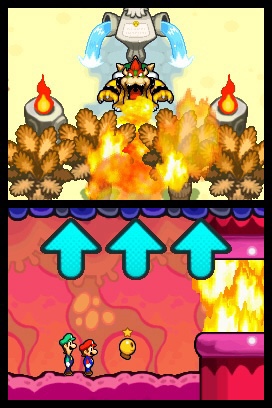
There are also the Giant Battles. These battles require the player to turn their DS on its side. Giant battles will see Bowser grow in size exponentially to fight large opponents. Some of the enemies Bowser faces off against includes the likes of a train, a robot windmill, and even his own castle. Players use the DS stylus to attack and counterattack. There isn’t really much to this kind of battle. It’s just kind of there. It doesn’t ruin the game in any way, but it also doesn’t improve it. It’s kind of cool when it first happens but the novelty of playing as a giant Bowser wears off by the second or third fight.

Exploration and level design has been greatly improved since the previous two games. The Mushroom Kingdom is incredibly fun to explore with a lot of things to find. For starters, the beans from the previous two games return and function the same as they did in Partners in Time. Bros. Attacks aren’t just given to you like they were in Superstar Saga or bought like they were in Partners in Time. Instead, Bros. attacks are found as puzzle pieces and are scattered throughout the different areas in Bowser’s insides. Upon finding all the pieces, you’ll unlock the Bros. Attack and be able to use it in battle. Bowser’s minions can also be found in the Mushroom Kingdom overworld, but instead of being scattered throughout they’re found all at once. There’s also a sidequest involving a new character known as “Broque Monsieur” who’s lost all of his pet “Blitties.” When finding all of the Blitties, you will unlock a new Brawl attack which features another pet of Broque Monsieur, “Broggy.” It also helps that Mario and Luigi can go into the Mushroom Kingdom and explore any areas only accessible to them to find secrets and such. The Mushroom Kingdom in this game is incredibly vibrant and has a lot of cool and interesting places. There’s Plack Beach which is a beach that has giant teeth scattered throughout it, Toad Town is a cozy little area, Dimble Wood is a standard forest area but still manages to be an enjoyable location, and then there’s even Bowser’s Castle which has been taken over by Fawful and turned into a movie theater. There’s also a few minigames that take place inside Bowser. Most of these are high score games and are introduced over the course of the story, requiring the player to experience them at least once or twice. There’s also some in game puzzles you could solve if you wanted a break from the main game. What’s more, you can even go back and have rematches against stronger bosses that Mario and Luigi have fought. And upon beating all of the bosses you’ll unlock one last, final tough fight against Bowser himself.

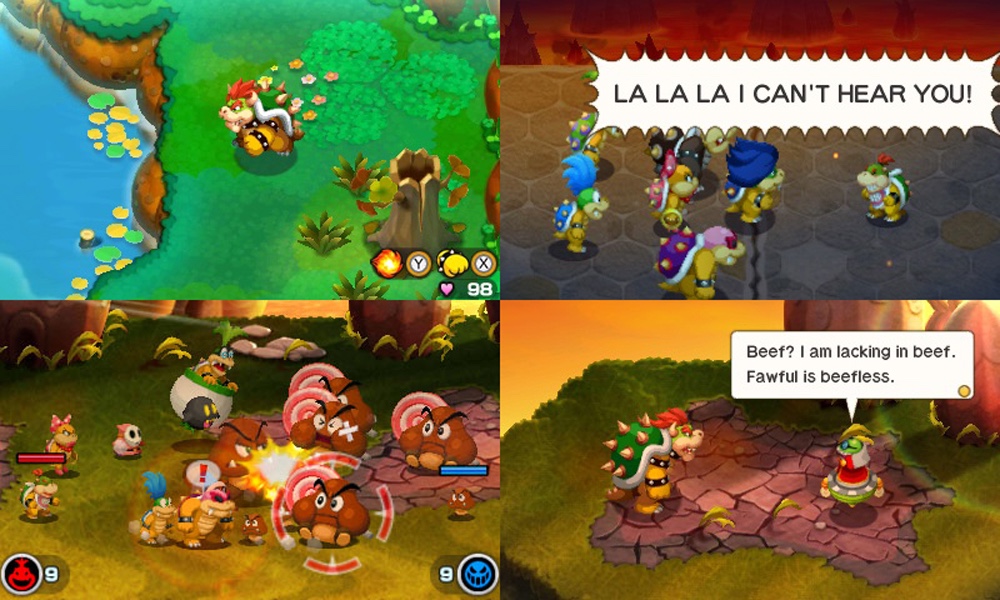
The game also got a remake in 2019 titled “Mario & Luigi Bowser’s Inside Story + Bowser Jr.’s Journey.” Unlike the previous remake which had some merit to it getting a remake such as finally being to play the entire series on the 3Ds, some minor gameplay tweaks to make the experience better, an extra albeit unnecessary story mode, and a graphical update, this game didn’t have a reason to be remade. You could already play this game on the 3Ds if you had the DS game, and it was mechanically and graphically sound and still holds up to this day. The change in artstyle this time around damages the game’s tone. Superstar Saga also had a similar problem with the change in artstyle, but at least the changes in that game made a lot of the areas look beautiful. This game looks significantly more boring in the new artstyle then the more colorful and cartoonish original style. Not many changes were even made to this game aside from a remixed soundtrack, amiibo support (all they do is give you items or coins), and an extra story. This extra story also doesn’t have any reason to be here as gameplay-wise, it’s a clone of the Bowser’s Minions mode from the Superstar Saga remake, just with Bowser Jr. as the protagonist. The story in this mode isn’t even that interesting, as all it does is introduce a couple of new villains that don’t have much screen time and aren’t really developed all that much and give Bowser Jr. some character development. The common complaint online is that the game should’ve been released on the Switch, considering the 3Ds was basically dead at the time the game launched and the Switch was already doing well three years in. I agree with that statement since the 3Ds didn’t need this game to be remade at all and it probably would’ve benefited better on the Switch than on the 3Ds, which was a dying console at the time of the game’s release. This remake is also up there as the worst selling Mario & Luigi game, which is ironic considering the original release of this game is the number one best-selling entry in the Mario & Luigi series. One thing this remake does do good in my opinion at least is give the Fawful fight near the end of the game its own unique boss theme. What’s more, the theme is a more ominous, slowed version of Cackletta’s theme from Superstar Saga, played on an organ, which is a pretty nice reference. I think this remake should’ve been given to Partners in Time instead since that game had a lot more things in it that could’ve used some fine tuning.
The music by Yoko Shimomura is also fantastic, as always. There’s a lot of really great and memorable tracks in this game such as “To A New Adventure,” “Oki Doki,” “Let’s Meet in the Mysterious Forest,” “Fawful is there,” “Beachside Dream,” “Tough Guy Alert,” “Grasslands, All the Way,” “Short Break in Toad Town,” and “The Grand Finale”. And whats more, some songs have an extra variation that plays when exploring inside of Bowser. Sound design, like the last two entries, is still great. I don’t even think I should mention this anymore because it’s always great.
This game is probably the best in the series as each game has at least something holding it back from reaching its peak potential. This game has a simple yet engaging story with an interesting premise and good gameplay. I never thought anyone could make a game in which one of the main settings is inside a body and make it not gross. I gotta give credit to the artist for this game just because of that. Fawful is such a delightfully entertaining villain with his broken English, strange metaphors, and his overall design and over-the-top attitude. The way he plasters his stupid grin on everything and how diabolical he is makes him a great villain. Bowser being a much goofier antagonist rather than a more threatening or imposing one is a great decision on the part of the writers, and I wish he was portrayed like this throughout the entire series, but that sadly isn’t the case. It’s also really cool how there is continuity in this series. Fawful went from being a mere sidekick to the main villain of Superstar Saga, to running a shop and plotting his revenge scheme in Partners in Time, to being the big bad of this game. The Shroobs even make a reappearance in this game as a secret boss, though they’re not that difficult of a fight if you find them near the endgame where you should be a high level. Also, the remake isn’t bad or anything, its just a slightly inferior way to play the game. I’d say that if you were to choose between either version, play the DS one. This game is amazing, its fantastic, its funny, and its really good, and I would highly recommend that you give it a try if you can.
Mario & Luigi: Dream Team
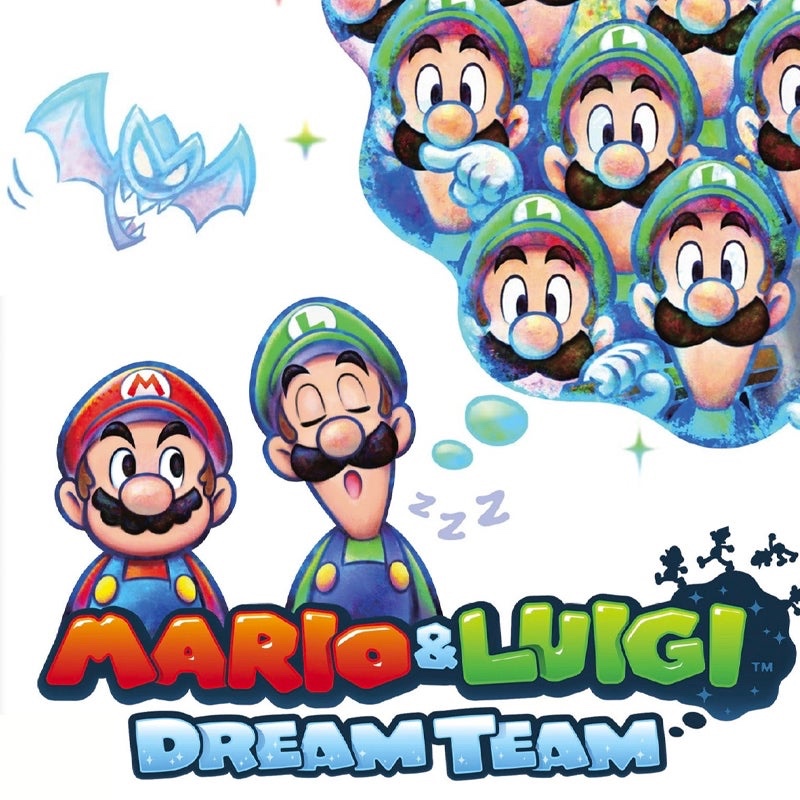
And now we enter the 3Ds era. Mario & Luigi was when the series changed its artstyle. Some fans dislike the new artstyle, but I’m personally fine with it, at least for these next two games. My only complaint with the change in artstyle is that it doesn’t feel like Mario and Luigi are as expressive as they were in previous entries. But the artstyle isn’t bad, its just different than what the series is used to. In order to understand this game though, we need to go back to the year of 2013. Mario & Luigi Dream Team released back in 2013, also known as the “Year of Luigi”, as Nintendo dubbed it. And, as many may know, the year of Luigi is infamously seen as a financial disaster for Nintendo. The premise behind the year of Luigi was to celebrate Luigi’s 30thanniversary and release games and merchandise centered around Luigi. Games such as Luigi’s Mansion Dark Moon, New Super Luigi U, and Dr. Luigi. Tons of weird things happened during this year. Of course, the real reason the Year of Luigi failed was of course because of the death of Danny Wells. Just kidding, but while his death was sad, this wasn’t the reason the year failed. The real reason the year was a financial disaster was the poor decision to dedicate the release of products to a character not everyone really cared (I cared about Luigi though, so I see this as an absolute success) about in addition to the Wii U just being a failure in general. The game we’re talking about though is Mario & Luigi Dream Team. Because 2013 was when the game was releasing, and the year was Luigi’s 30thanniversary, Dream Team puts a big focus on Luigi as Luigi is integral to the game’s plot, gameplay, and mechanics.
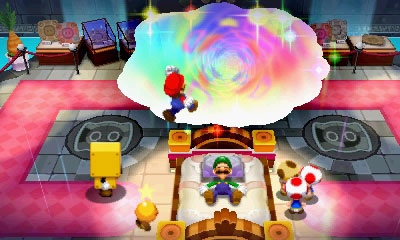
The story this time is that Mario and the gang are invited to come to an island known as Pi’illo Island. After Luigi is knocked unconscious due to falling on the ground after waking up from a nightmare, Mario and Luigi later meet up again at Pi’illo castle where they meet up with Starlow again. They go down to the bottom floor of the castle where they watch a video and are introduced to Dr. Snoozemore, who explains the history and lore of the island. Peach then steps onto a platform accidently and is blasted off into the depths of the castle. Mario and Luigi then must chase after her in order to find and rescue her. They eventually do find her alongside a rock shaped like a pillow. They take this rock, and they all make their way out of the depths and into the castle’s treasure room. When in the treasure room, Luigi decides it’d be a great idea to lay down on the off-limits royal bed and use the rock as a pillow. Upon doing so, Luigi falls asleep instantly and a portal appears over his head. Peach, curious decides to inch closer to the portal, which inevitably leads to her getting sucked in, meaning Mario has to dive in and rescue her. When he finds her inside of the portal, a purple cloud carries her away, with Mario chasing after it. Mario later finds Luigi inside the portal and concludes that he’s inside of Luigi’s dreams. But this isn’t actually Luigi, rather a manifestation of what Luigi thinks of himself. This manifestation of Luigi is nicknamed Dreamy Luigi [dreamy indeed ( ͡° ͜ʖ ͡°).] Mario and Dreamy Luigi give chase to the purple cloud, but it eventually gets away. Mario and Dreamy Luigi then stumble upon a purple rock calling out to them. Mario breaks the rock and out comes a spirit. Upon returning to the real world, the rock Luigi was sleeping starts to rumble, waking Luigi up. The rock then turns into the same spirit from Luigi’s dreams and reveals themselves to be Prince Dreambert, the prince of the former Pi’illo civilization. Dreambert then explains how he and the Pi’illo folk ended up as rocks, detailing how the purple cloud seen in Luigi’s dreams was actually an evil being by name of Antasma. Long ago, Antasma sought the power of the Dark stone, one of two stones that could grant wishes. The Pi’illo folk decided to seal him away in the Dream World, but before he was completely sealed away, he crushed the Dark stone, causing all of the Pi’illo folk to turn into stones. And now he’s back, seeking the other remaining stone, the Dream stone. And you know the drill at this point, Mario and Luigi need to rescue Peach, stop the bad guy with the help of new characters, whacky hijinks ensure, etc.
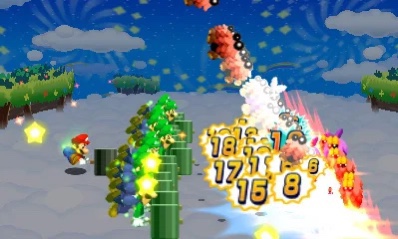
Gameplay remains the same as it did in previous entries, though there aren’t any additional characters this time around like Bowser or the Baby bros. Battles in the real world basically just have Mario and Luigi doing what they do best, attacking by either jumping or using hammers, executing Bros. attacks, etc. Its in the Dream World where the gameplay in combat changes, as Luigi isn’t present during combat sequences in the Dream World. Instead, Mario is aided by “Luiginoids” in the Dream World. All this really does is make Mario’s attacks significantly stronger. And while the player may only have one turn compared to the two turns, they get in the real world, if they time their button presses during a move correctly, a bunch of Luiginoids can follow-up on Mario’s attack, which results in extra damage dealt to the targeted enemies. Bros. Attacks are also gone in the Dream World, instead being replaced with Luiginary Attacks. Luiginary attacks function the exact same as Bros. Attacks would. An example of some of these attacks would be Mario rolling a giant ball of Luigis, absorbing other Luigis in the process in order to make the ball bigger before kicking it into a group of enemies. This entire attack is done by tilting the 3Ds. The 3Ds’ main feature, the “glasses-free 3D” also comes a little into play here, as the 3D can actually enhance depth perception for some of these attacks, like the Luiginary ball. The game also takes a note out of Inside Story’s book, with the real world acting like a normal overworld that we’re familiar with from other Mario & Luigi games and the Dream World instead being set in a 2D plane. Unlike Inside Story though, the Dream World does not have a hub world, and is instead accessed by having Luigi sleep on various stone pillows throughout the real world. Most of these are little mini levels which sees the player exploring a smaller area in order to find and break any purple chunks they see to free the Pi’illo trapped. Upon freeing the Pi’illo, you can always talk to them and ask if you can go back into that small area of the Dream World, so don’t worry about potentially missing anything because you can always go back. A big feature in the Dream World though is the giant Luigi on the bottom screen. This is where the Luigi dating simulator feature comes into play as you can mess around with the sleeping Luigi on the bottom screen either for pleasure or to affect certain things in the Dream World. For starters, Dreamy Luigi can turn into a tree at certain points, and by using the stylus to pull Luigi’s mustache, the branch of the Luigi tree will start to move corresponding with the movement of Luigi’s mustache. Other things that can happen include making Luigi sneeze to muster up some strong winds, adjust the temperature of the area Luigi’s sleeping in to make the Dream World either sunny and sturdy or cold and slippery, adjust the raft Luigi is sleeping on to change the gravitational pull of the Dream World, and more.

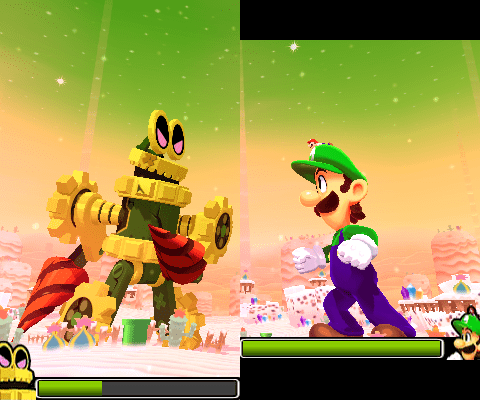
The giant battles from Inside Story also return, but they’re done much better here. At certain points in the story, Dreamy Luigi will make himself bigger in order to take on larger opponents. Giant Luigi can jump, knock enemies backwards with his hammer, knock them into the background with his hammer, call upon Mario to heal him, or work with Mario to perform a spinning jump among other things. The giant battles here are a lot more interesting and engaging then they were in Inside Story due to the varied methods of attacking as well as the different scenarios they present. For instance, at some point in the story Giant Luigi will square off against a giant volcano. Giant Luigi is not able to jump on the volcano otherwise he’ll burn himself, taking damage as a result. Instead, the player has to knock him backwards with the hammer, causing him to go flying and landing on his back, causing him to lose a turn and give the player the ability to jump on him until he gets back up. All of the giant battles have some sort of interesting gimmick about them, though my only complaint with these battles doesn’t come into play until near the end of the game. The last two final giant battles feature motion controls, and they don’t work well when you have the 3Ds tilted on its side. When trying to tilt the 3Ds to control Giant Luigi in these sections, he doesn’t respond most of the time to the tilting, making these sections frustrating. Upon beating each giant battle though, Giant Luigi will leap into the sky, grab a super star which Mario hops on, and then he throws it back down to the earth. Players control Mario as he rides on the super star to land the finishing blow on the boss, which is pretty satisfying.
Exploration is once again pretty good, as you can always go back to areas you previously couldn’t access after unlocking new abilities for the bros. In the Dream World though, Mario and Luigi use abilities different from the ones they use the real world. These abilities are the Luiginary abilities. These abilities function the same as the abilities in the real world but are different in concept as their more adjusted to deal with scenarios for a 2D plane. Some of these abilities allow Mario to ride atop a tower of Luigis and jump really high, ride atop a ball of Luigis and use it to swing and grapple to certain areas, or even ride atop a bunch of Luigis in the shape of a clone and create a tornado of Luigis that allow Mario to cross large gaps. The beans are also back and can be collected in the real world. There are also Pi’illo folk to save which gives incentive to explore each area thoroughly to find more Pi’illo folk. There are also the attack pieces which were first introduced in Inside Story, where finding a certain number of them will give the duo a new Bros. attack. These attack pieces can be found both in the real and dream world, real world attack pieces give the player Bros. attacks while the attack pieces in the Dream World give players Luiginary attacks. There are also a variety of minigames scattered throughout the world that you can participate in to get a high score and certain rewards. Like Inside Story as well, you can refight harder versions of previous bosses and if you beat all of them, you’ll get to fight a secret boss. Upon beating the game, you’ll gain access to a harder version of the game. This is the only game in the series to do this which is pretty cool and adds some replayability to the game. These areas are also all look really nice. This game of course is the series’ transition into using more 3D models so the world can look a bit off in certain areas, but it looks natural for the most part and isn’t that much of a complaint. Every area looks beautiful, cozy, and lived in. Wakeport is probably one of my favorite locations in the game due to all the houses and buildings you can explore, minigames present, and the side quest where you trade items among the various residents of the town. Mount Pajamaja starts off a rocky mountain but as you ascend and get closer to the summit, you’ll enter the snowier parts of the mountain. Somnom Woods also looks really nice, and I like the atmosphere it brings.
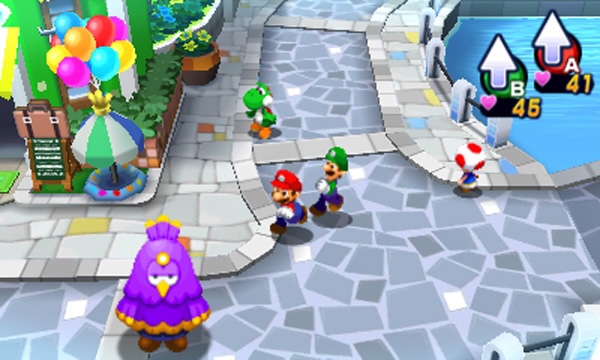
The music accompanying these locations are also amazing. I personally believe this game has the best soundtrack in the entire series, but of course, music is subjective and this just my personal opinion. So many great songs like “Your Dream Adventure,” “Try, Try Again,” “Never Let Up,” “Breezy Mushrise Park,” “Size Up Your Enemy,” “Shopping in Wakeport,” “Lofty Mount Pajamaja,” “Sunny Driftwood Shore,” “Sacred Somnom Woods,” “The Final Antasma Battle” and “Adventure’s End.” The sound design in general is also really good if not better thanks to the gift that is the sound of many Luigis speaking in unintelligible Italian gibberish.
I really like this game, but I do have some problems with it. For starters, I wish the Dream World reflected Luigi’s personal view of the areas, because all the Dream World really is, is just a version of the area you’re in but with watercolor backdrops. They should put some kind of unique spin on these locations in the Dream World, like maybe have a wrestling or arena theme to the Dream World version of Wakeport to make it a bit more unique and feel more like a “dream world.” There is an area known as “Dreams Deep” which is supposed to be the deepest parts of Luigi’s dreams, and it really feels like a pile of missed potential. Most of the area consists of many Luigis floating around and talking about how much they care about and want to help Mario. This entire area gives us the same basic information that the original Paper Mario managed to give us in Luigi’s diary. They could’ve done something more here like maybe touch on his fear of ghosts, maybe even touch on some of the more obscure lore behind Luigi such as his desire to be a great plumber or how he can play the violin. Hell, if you’re going to touch upon him wanting to help his brother out more, you should try to do it in a more visually interesting way instead of just a dark void with floating text in the background. The major complaint I have with this game though is its sheer length. A majority of this game is nothing but text, which is understandable for a game that has a story that hinges a lot on events from the past, as you’d obviously have to explain these events and give the overall setting and characters some lore. But that isn’t the problem, the problem is the number of tutorials. This game holds your hand so much throughout the entire experience. It never lets you try to figure out things on your own, and it does so in elaborate ways sometimes. The game gives you a tutorial on the basics of battling at least 3 times at the beginning of the game. Every single mechanic and puzzle, the game comes to a halt so it can explain to the player how to solve it. This combined with the amount of text relating to the story makes this game significantly longer than it needs to be. I’m able to beat the other Mario & Luigi games around 15 to 25 hours, this game took me 46 hours to beat. Another small problem I have is how Bowser’s character is handled. After coming off from Bowser’s Inside Story, which made him a lot sillier and comedic, I can’t really take him seriously as a menacing or formidable foe that this game tries to make him to be. But that’s a small problem for me, not everyone may see this as a problem though, and that’s fine.
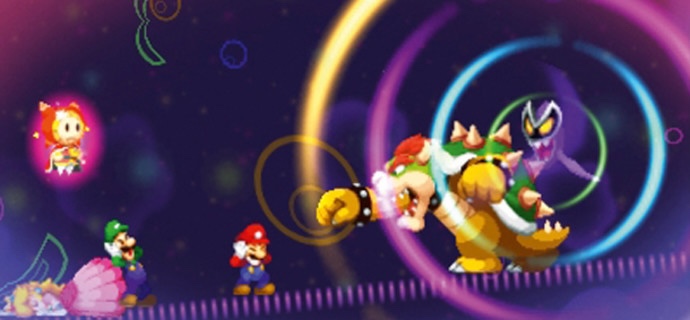
The game, while long and tedious at times, is still great fun. I love the emphasis on Luigi in the game and the revamped Giant Battles. Pi’illo Island is also a really cool location visually and I wish it were real. The humor is still pretty funny for the most part, I like the combat in the Dream World, and the game having a hard mode is definitely appreciated even if I don’t really want to try it because I don’t want to sit through a ton of text again. This is another game I would recommend, but only if you’re able to tolerate large amounts of text.
Mario & Luigi: Paper Jam
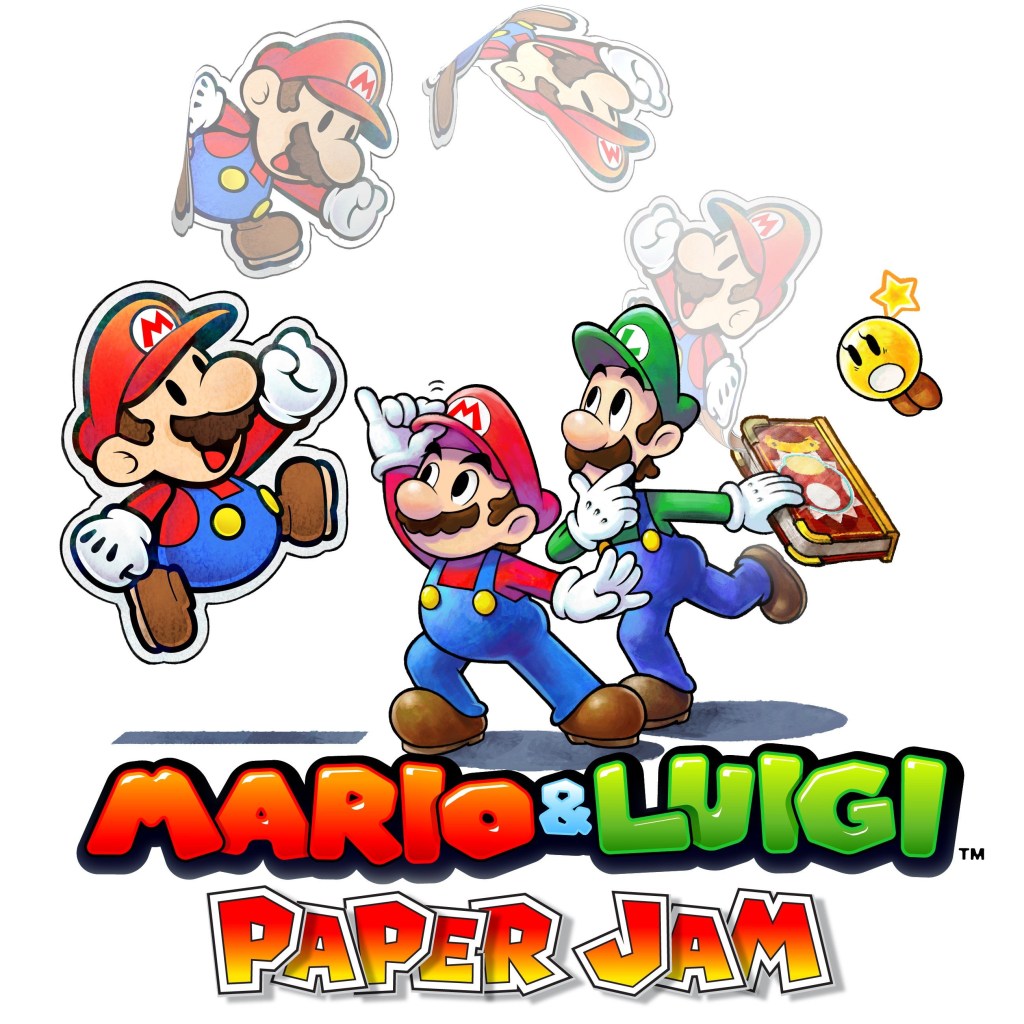
And now we arrive at the final entry (that isn’t a remake) in the Mario & Luigi series. This game was released back in 2015. The game is a crossover between the Mario & Luigi series and the Paper Mario series. Sounds pretty cool, right? Unfortunately, this was the time period where Nintendo started to “dumb down” the Paper Mario series. The previous Paper Mario game, Sticker Star, was slammed by fans due to how it dumbed down the Paper Mario series, introduced a new and unfun gameplay style, and had a basic story. The first two Paper Mario games were praised for their enjoyable stories and fun and interesting gameplay. Super Paper Mario was a lot more mixed but most agreed that while the gameplay was a great departure from the previous two games, the story was incredibly good. Paper Mario Sticker Star released on the 3Ds near the start of the system’s life cycle and Paper Mario Color Splash was released a year after Mario & Luigi Paper Jam. Sticker Star and Color Splash were also criticized for not introducing new and compelling characters like past games and instead relying on already established Mario characters and enemies. When this crossover was announced though, many were wondering if they would go the Mario & Luigi route with the story by potentially bringing back older characters and villains from both series in this crossover to tell an interesting story or even create entirely new characters, or if they were going to go in the direction of the Paper Mario series was heading and tell a simpler and more basic story. What we got was the latter.
The story this time around is that Luigi and a Toad is looking around in a storage room in Peach’s castle to get rid of a rat. Luigi accidently freaks out when he encounters the rat and knocks a book off the shelf. The book opens and the Paper counterparts to the characters spew out of the book. Paper toads are then found running around and hiding in Peach’s castle, so Mario is tasked with finding them all. Afterwards Peach meets Paper Peach and Paper Peach. Meanwhile Bowser meets Paper Bowser and despite their disagreements, they decide to join forces. Mario and Luigi later meet up with Paper Mario. Upon returning to the castle, they discover that the two Bowsers have kidnapped both princesses. They then set off to rescue the two princesses. Throughout the story they’re confronted by various enemies who’ve teamed up with their paper counterparts (They also encounter the Koopalings but they don’t have paper counterparts in this game). As you can see, this is a very basic Mario story. This can technically be said about the stories of all other Mario & Luigi games, but they had something unique about them. For example: Peach’s voice is stolen, Peach is being held captive in the past by aliens, Peach and every were inhaled by Bowser, Peach is captured by a dark entity who was sealed away in a dream world, they all have something to the premise of Peach getting kidnapped. In this game, Bowser kidnaps Peach, but Paper Bowser also kidnaps Paper Peach. Not a very interesting setup compared to the other games.

Gameplay here is also the same as it is in the Mario & Luigi series. This time around, Paper Mario joins the party. Just Paper Mario, no Paper Luigi, he’s probably chilling on an island or something somewhere. Paper Mario is controlled with the Y button and is unique compared to Mario and Luigi because of how weak he is. Though while Paper Mario be incredibly weak, he can make himself stronger by using the new “Copy” command which is exclusive to him. By using the copy command, Paper Mario can create multiple copies of himself to assist him. If Paper Mario has, say, 6 copies of himself, he’ll be able to jump on an enemy a total of 6 times if the player times their button taps right. He can also deal extra damage with his hammer. Whenever he’s hit, if he has copies, they’ll be taken out instead of him taking any damage. If he’s hit when he doesn’t have any copies, then he’ll take damage. In addition to the Bros attacks returning, there’s now the Trio attacks, which are attacks performed by all three characters. These attacks function the same as Bros attacks, just with three characters instead of two.

Badges, which have been a series staple up until now are done away with and replaced with Battle Cards. The battle cards function similarly to Badges as they give you slight boosts in battle. You can build your own deck with each card having a different effect in battle. Three cards can show up on the bottom screen of the 3Ds at a time, meaning the rest are randomized. You’ll have to redeem Star Points to use a card though as each card requires a different amount of Star Points to use. The stronger the card, the more star points it’ll require. You can get Star Points by executing successful moves in battle. Certain amiibo from the Mario series can also bee scanned to get cards based on those characters. You scan only scan an amiibo once a day and get one card based on that amiibo before you have to wait until the next day. The roulette wheel that appears when leveling up is also done away with in this game. This is a change I’m not very thrilled about since with the roulette wheel, You where able to customize the characters to suit your play style when leveling up, now the only way for you to do that is by using beans.
There is also the new “Papercraft Battles.” These battles are essentially spiritual successors to the Giant Battles from the previous two games, just less fun. The Papercraft Battles sees the player operating a giant Papercraft of certain Mario characters like Mario, Luigi, Peach, or Yoshi as they fight against other Papercrafts. These battles essentially boil down to ramming into other enemies or jumping on top of them all while running around in an arena. The Papercraft Battles are fun the first few times but become boring and repetitive very quickly.
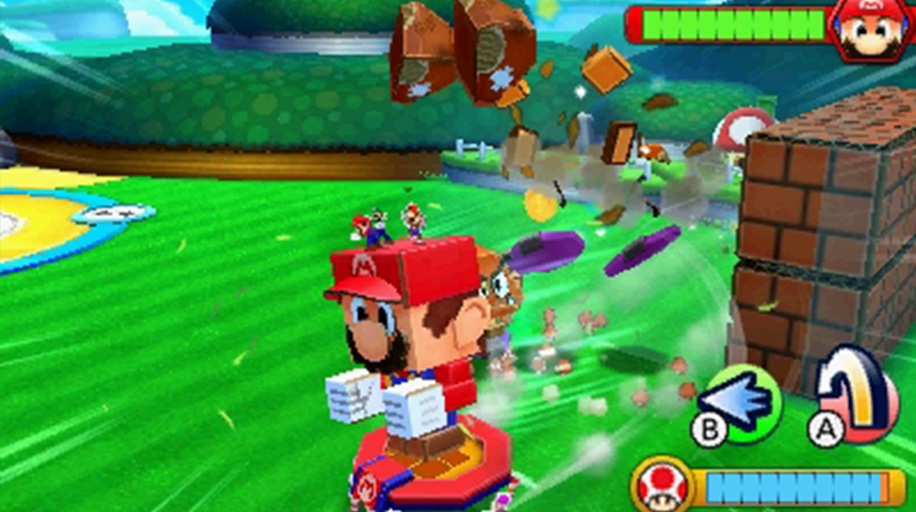
This is also probably the least interesting world to explore in the series. All of the areas you explore in this game follow the same generic themes we see in the New Super Mario Bros. series like grassland, desert, forest, snow, and lava, I guess. Exploration in this game feels significantly stripped down compared to the previous two entries as those games had tons of things to do in the world and even secrets to find. This game also feels the need to interrupt the story at times to make the player go around searching for Paper Toads either by playing hide and seek, chasing them down, or saving them from enemies. These are fun little distractions the first few times they’re introduced but become tedious the more the game makes you do these.

The music in this game is still good as always. Like previous games before it, there’s a lot of good tracks here like “Springtime Breeze,” “Epic Story,” “Welcome to the Lakitu Welcome Centre,” “Tea Time on the Clouds,” “Time’s Running Out,” “Where’s Toad,” “Mixed-Up Scramble,” “Big Bang,” “Double Bowsers,” and “Final Battle.” There’s even a remix of “Come On!” from Superstar Saga that plays during battles before meeting Paper Mario as well as a remix of Peach’s Castle theme from Mario 64.

I think this game is fine, but it’s definitely nowhere near as good as the other games in the series. The game had a lot of potential to do something interesting with its crossover idea, but it really dropped the ball. The game is still fun, its still a Mario & Luigi game, but there are better entries in the series then this one. Not having any original characters and instead choosing to rely on using exclusively pre-established characters from the mainline Mario games really does hurt this game as well. But I wouldn’t recommend this game when there are obviously better games in this series on the 3Ds that you can play instead like Dream Team or the Superstar Saga remake.
In Retrospect
I love this series, and I’m sure many others do to. Everything about it from its whacky characters, unique settings and locations, fun gameplay and good humor helped make it so memorable. Sadly though, we won’t be seeing any new entries in the series for the foreseeable future, because as of 2019, AlphaDream declared bankruptcy. This was due to declining sales with games like Paper Jam, the Superstar Saga remake, and the Bowser’s Inside Story remake in addition to high development costs. But all of these games were great and I don’t feel as though they get the same love and attention other Mario spinoffs get like the Paper Mario or Mario sports series. I would like to take this opportunity to thank the writers of this game, because without them this series wouldn’t be as great as it is. Most of these games’ identity comes from the writing in these games. The hilarious jokes, wonderful characters, and whimsical stories. These games provided a unique experience to many players, which is why it’s so sad to see the series join some of the other extinct Nintendo series. But who knows, maybe one day we’ll see the series return and introduce a new generation to a series of great Mario-themed RPGs. And I know that myself and many others will be waiting until then.
Mario & Luigi Superstar Saga was reviewed on Gameboy Advance and Wii U.
Mario & Luigi Partner’s in Time was reviewed on the Nintendo DS and Wii U.
Mario & Luigi Bowser’s Inside Story was reviewed on the Nintendo DS.
Mario & Luigi Dream Team was reviewed on the Nintendo 3Ds.
Mario & Luigi Paper Jam was reviewed on the Nintendo 3Ds.
Mario & Luigi Superstar Saga + Bowser’s Minions was reviewed on the Nintendo 3Ds.
Mario & Luigi Bowser’s Inside Story + Bowser Jr.’s Journey was reviewed on the Nintendo 3Ds.
Written from October 18th to October 21st.
 The Squeeble Site