
The Kingdom Hearts series is a franchise that is held near and dear to many people’s hearts, and over the years has achieved meme status with how complicated its story is. This is a retrospective on the series as a whole, starting with a summary of the series and the creation. Following the creation, the games themselves will be covered by chronological release. And then additional information for the series will be covered. For example: a complete timeline for anyone who may be interested into getting into the series.
A warning for minor spoilers in the series. Certain characters and events may be referenced later in this retrospect but any big or major spoilers for the series won’t be covered here. But with all that said, let’s start with the summary and the initial creation of the series.
Summary
The Kingdom Hearts series follows a young boy named Sora, who is accompanied by Goofy and Donald Duck as they go around across worlds from various Disney films. Within these worlds, Sora and company will interact with familiar Disney characters and defend the world from enemies. In addition to this, they cannot interfere with the worlds too much though, as it can cause unspecified “problems” later down the line (exactly how much they can interfere is never specified). Sora’s actions in these worlds either follow one of two storylines: a story that follows the plot of the original Disney movie a world is based on, or a plot that follows the setting and characters from a Disney movie but the plot itself is entirely unique. The overarching plot of the series though follows an event known as “The Keyblade War”, a war that took place many years before the first game. The main antagonist of the series’ main goal is to gather “Seven Guardians of Light” and “13 Darknesses” in order to create the “X-blade” and set off a new Keyblade War.
Initial Creation
The series was and still is commonly known for its premise of mixing Final Fantasy with Disney. This started off as a collaboration with Japanese game studio, Squaresoft (known as Square Enix now), and Disney. The series’ can also be described as “one of the greatest elevator pitches of all time”, more on that in a bit. The idea originally started with Squaresoft wanting to make a game similar to that of Super Mario 64, a game that was to take use of a third dimension and offer lots of freedom in movement. They then lamented the fact that only Disney characters could rival the popularity of Mario at the time. Tetsuya Nomura (The lead character designer of Final Fantasy 7 at the time) overheard the idea and volunteered to direct the project. At the time, Square and Disney both worked in the same building in Japan. This shared building was crucial to bringing the concept of Kingdom Hearts into fruition. The producer of the project managed to meet a Disney executive in the elevator. While in the elevator, the producer pitched the idea to the executive, in which the project was greenlit on both sides with development following shortly after.
Kingdom Hearts/Kingdom Hearts: Final Mix
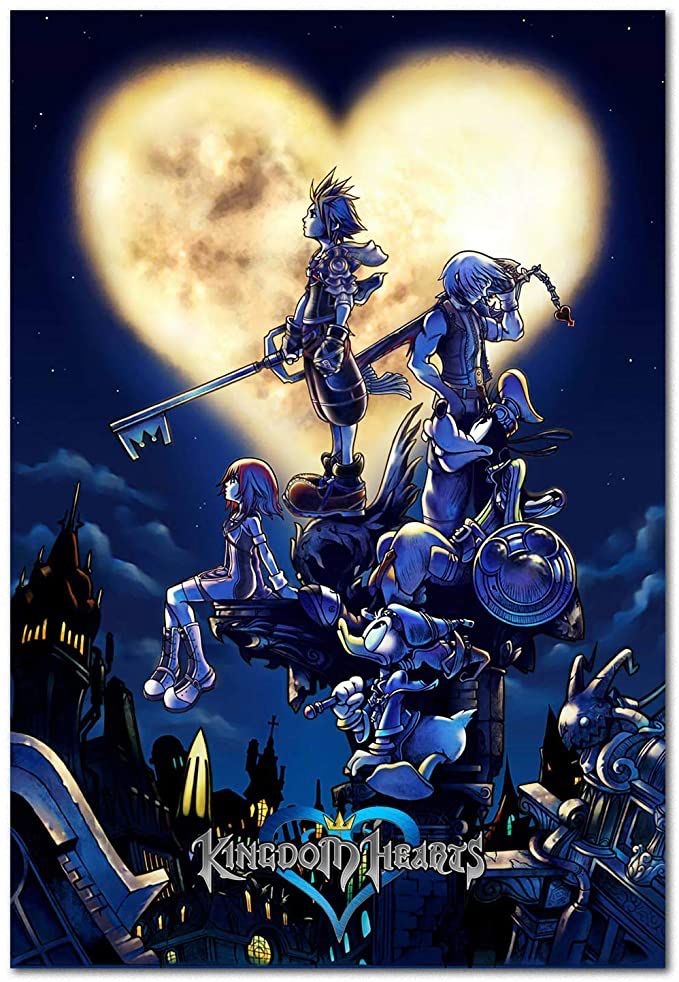
And now we’re at the first entry in the series. I’ll explain the basic premise of the story without spoilers first. The game starts off with players taking control of the main character, Sora, and shows him and his two friends: Riku and Kairi. To make a long story short, their world: Destiny Islands is destroyed, and Sora ends up in a world called “Traverse Town”, a world that serves as a refugee for those who lost their worlds. This darkness that is spreading across worlds are known as “the heartless”, beings that form when one’s heart is separated from them. This is basically all the plot that really matters at first. Everything that’s directly related to the story happens near the end of the game.

The main game is a third-person action-rpg, with elements of a hack-n-slash game thrown in as well. Players will get into fights with the Heartless (the enemies of the game) and will fight them either using their keyblade or various spells. At the beginning of the game, players will be tasked with choosing between a sword, shield, or staff. Choosing the sword will raise attack power, choosing the shield will raise defense, and choosing the staff will increase the magic meter. After choosing one of these items, players will them have to choose which one they want to sacrifice. Depending on what you choose will affect Sora’s stats throughout the adventure. This is a crucial part of the game, since it can drastically change how you approach boss fights. In addition to this, there obviously items you equip to change your stats and give you resistances to certain attacks. After completing each world, players will also be rewarded with a keyblade based off of that world, and in normal rpg fashion, the new keyblade you obtain will most likely end up replacing your currently equipped keyblade due to it having better stats. As I’ve mentioned before though, players control Sora, but what about Donald and Goofy? Those two characters are controlled by an artificial intelligence and are not playable. Donald is the most infamous party member among the Kingdom Hearts community, mainly due to the complaints, jokes, and memes about how he’s a mage skilled in both white and black magic that never heals you. This information is false, as while he’s automatically set by defualt not to heal you, you’ll have to go into the “customize” menu and alter how he approaches battle yourself. In certain worlds, guest party members can join your party as well, but only for that world. For example, in Agrabah, Aladdin can join your party. Aladdin can only exclusively be used in Agrabah though, this is the same for other extra party members. It should be noted that you can only have two other characters in your party at once. This means that players will have to decide if they want to replace Donald, Goofy, or neither. The games combat can best be boiled down to mashing the attack button. The game features real-time combat, and most players starting out will spam the attack button. But new players should know that magic is somewhat broken in this game. Spells like Thunder, Cure, Stop, and Gravity are all very useful spells in certain circumstances, especially some of the third-tier versions of the spells. In addition to magic though, there are also summons. Summons are similar to that of the summons from Final Fantasy, just with various Disney characters. The characters players can summon are: Simba, Genie, Bambi, Dumbo, Tinker Bell, and Mushu. Summons require both party members to be alive while in battle. You unlock summons by finding them throughout the various worlds.

Naturally though, the entire game isn’t just combat, as there is still the worlds players will explore. In Kingdom Hearts, players will end up exploring a total of 10 (11) worlds, with one optional world. These worlds include: Destiny Island (Kingdom Hearts), Traverse Town (Kingdom Hearts), Wonderland (Alice in Wonderland), Deep Jungle (Tarzan), Olympus Coliseum (Hercules), Agrabah (Aladdin), Monstro (Pinnochio), Atlantica (The Little Mermaid), Halloween Town (The Nightmare Before Christmas), Neverland (Peter Pan), and Hollow Bastion (Kingdom Hearts). One optional world is The Hundred Acre Woods (Winnie The Pooh), which serves mainly as a minigame area due to its lack of enemies and exploration and emphasis on minigames.
Destiny Islands doesn’t have too much to it in terms of exploration but is a good tutorial level to introduce players to the game and its mechanics.
Traverse Town similarly is a good tutorial area, but also serves as a good world in general. There’s the main shopping district that features Cid from Final Fantasy VII selling gummi block (more on those later) and Huey, Duey, and Louie selling various items and gear. This is also where players first see the Final Fantasy series’ Moogles, who appear mainly as merchants in the Kingdom Hearts series as a whole. For a world that seems small when compared to other worlds in the series, it makes up for in its good music, abundance references, small little details, and overall atmosphere.
Wonderland is a world based on Disney’s adaptation of Alice in Wonderland and sees players running around these weird box cube-shaped areas. I personally never found the area to be that fun and thought that the design of the world, whether intentional or not, was very claustrophobic and oddly ugly to look at in certain areas. The next world is by far, the most forgotten and or hated world in the Kingdom Hearts community,
Deep Jungle. This world has not made a reappearance in the series since the first game and that may be because of either copyright issues with the film or due to it being a relatively unfun world to explore. A lot of the areas look similar to each other, making it a bit hard to know where to go. In addition to this, the world mainly boils down to climbing up a tree, climbing down back to the campsite, only to rinse and repeat the process.
The next “world” is Olympus Coliseum. This world isn’t really too much of a world, with it only having a total of three rooms. This is mainly because it’s a gauntlet of sorts. Players can take on various challenges from defeating a wave of enemies to facing off against Cloud Strife from Final Fantasy VII.
Agrabah is a fine world as well, starting off in a relatively small portion of the city then later letting players explore the interior of the Cave of Wonders which features tons of traps and hazards on the way down to treasure within. Monstro is also disliked by a portion of the Kingdom Heart community, due its confusing maze-like structure. All rooms are named “Chamber” with a number following the name in addition to each room having a similar layout which can add to the confusion. The game does attempt to help direct players where to go though, by making the correct passages glow green in addition to spawning a green enemy above them to make it a bit more obvious.
Atlantica is also notorious among the community, mainly due to its awful swimming controls. The controls are the main problem with this world, as they can be hard to grasp a lot of the time. It also doesn’t help that similar to Monstro, it features locations that look similar to each other, although to a lesser extent.
Halloween Town is a fantastic world in both level design and theme. The only problem with the world is Lock, Shock, and Barrel’s hideout. Their hideout is highly elevated and tasks players with climbing up to the top of the structure. The problem is that there are no barriers to stop players from falling off. If players do fall off, then they’ll be forced to make the long climb back up. It also doesn’t help that are numerous enemies that are airborne and hover away from any solid ground, forcing players to deal in aerial combat to take them down and potentially risk falling. But other than that, an overall great world.
And there’s Hollow Bastion, the penultimate world of the game. The world tests everything you’ve learned in the game up to this point as you scale a towering castle-like structure. The atmosphere and music are intense as it prepares you for the final battle. There is one more world, but it isn’t really too much of a world, and I also can’t talk about it without potentially covering spoilers.
And there is one optional world being “The Hundred Acre Woods” from Winnie The Pooh. The world is unlocked after collecting 10 of the missing pages from the Winnie The Pooh book from across the worlds and delivering them to Merlin (Sword in the Stone) in Traverse Town. The world doesn’t have many things to do aside from various minigames.
Even after making it past the final world in the game, there are still things to do in the game. For starters, player’s can collect all 101 dalmatians scattered across various worlds. There’s also the gummi ship segments. In order to get to other worlds, players will take the gummi ship to travel to them. These parts of the game serve mainly as a way to pad out the game, with them being pretty much a Star Fox clone. Players can customize their gummi ship and that’s all there really is. Nothing too interesting about it.
And then there’s the Final Mix version. This version includes new bosses, new weapons, new enemies, new abilities, new cutscenes, new collectibles, and a secret movie teasing the following game (Kingdom Hearts II, not Chain of Memories). Music is also fully orchestrated in this version, with a few extra songs being added (I can’t remember if this was in the original Final Mix or in the version present in the 1.5 ReMix version of the game).
The music and voice actors should also be recognized as well, with the music for the game and the entire series being done by Yoko Shimomura. A lot of great original tracks such as “Traverse Town”, “Monstrous Monstro”, “An Adventure in Atlantica”, “Spooks of Halloween Town”, “Hollow Bastion”, “Scherzo di notte”, “Forze de Mal” and many others. Tracks from Disney films can also be heard like “Under the Sea”, “Mickey Mouse Club March”, “This is Halloween”, “Winnie The Pooh” and in Final Mix there’s a bonus track that includes the Fantasia performance of “Night on Bald Mountain”. The two most memorable songs though have to be “Dearly Beloved” and Japanese Pop singer, Hikaru Utada’s “Hikari”. And there’s also the voice actors. Some Disney veterans reprise their roles as their characters such as Tony Anselmo and Bill Farmer voicing Donald and Goofy respectively. A few other veterans including Jim Cummings (Winnie The Pooh/Tigger), James Woods (Hades), Gilbert Gottfried (Iago), Jodi Benson (Ariel), and many more. And then there’s the voice actors who play the characters made for the game. Haley Joel Osment does a great job playing Sora and David Gallagher also does a great performance as Riku. Billy Zane does a spectacle performance as his character, though it is sad that he was replaced in the following entries of the series. The overall sound design is also really good, with each strike of the keyblade always sounding really satisfying when in combat.
This game serves as a great first entry to a new series. A few improvements can be made, such as level design and its slower combat (at least compared to other entries), but it still does a good job at laying the foundation for a new franchise.
Kingdom Hearts: Chain of Memories/Re:Chain of Memories

And now we’re at the second entry in the series. You’d think a game that has a weird subtitle instead of the number “2” and released on a console that had no entry in the series prior would be considered a “spinoff”, but no. It’s completely canon and crucial to the series’ overarching story. This is one strange game when compared to the others. Largely the reason behind why it is a black sheep when compared to other titles is because it doesn’t really play much like a traditional Kingdom Hearts game. The game is a card game with rpg-elements thrown into it for good measure and it was made for Nintendo’s Gameboy Advance before getting the remake treatment and being thrown into the 1.5 ReMix collection for the PS3. The game takes place directly after the events of the first Kingdom Hearts game, with Sora, Donald, and Goofy stumbling across “Castle Oblivion” while still searching for Riku, and the King. While in the castle, they run into the antagonists of this title: “Organization XIII”. Basically Sora’s memories are represented by cards, he uses these cards to travel to familiar worlds while also using them to attack and use items. The more they progress through the castle, the more memories they lose. Upon beating Sora’s story, there is an extra post-game story following Riku. While Sora scales the castle, Riku descends further down accompanied by Mickey Mouse, facing off against his past and the other members of Organization XIII.
As mentioned before: this is a card game. Players will have a deck of cards that can be upgraded to include more cards in their deck as they level up. Each card has an individual value that indicates how powerful the card is. If a player runs out of cards in their deck in battle, they will have to reload, leaving them vulnerable to attacks. There are three card types: Attack cards, Magic cards, and Item cards. There are also various special cards that have varying gimmicks depending on the card. Each card has a number from 0 to 9. The card with the lower value that is played will “break” and will either leave the player or enemies vulnerable depending on who threw the lower level card out first. Cards that have the “0” value can either be the most worthless or most powerful cards in the game depending on when they’re used. If they’re thrown out first, then any card with a value higher than 0 can trump it. If the 0 is thrown out after another card was thrown out, it automatically trumps the other card regardless of how high the value is. The there’s “sleights”, special abilities that can be gained via leveling up, defeating bosses, or finding them in chests. Players can combine their cards into sets of three. Combining cards not only makes the value higher, but also makes the card harder to break. Combining cards is also essential when it comes to activating sleights. The first card that is used in the combined set can not be used for the rest of the battle unless a certain item is used to reload the deck such as an Elixir. And this is only Sora’s combat.
Then there’s Riku, the character with a completely optional story upon beating the game. Unlike Sora, who can either increase his Health, Combat Points, or unlock a new sleight, Riku can either increase his health, attack power, or “dark points” when he levels up. Riku’s various powers that he uses in battle can be triggered by either taking damage or breaking enemies’ cards. When Riku’s dark points reach 30 or higher, he will automatically go into “dark mode”. While in dark mode, Riku gains access to 3 sleights that are exclusive to this form. The amount of dark points he has directly affects how long he can stay in this form. Taking damage or having your cards break while in this form will reduce the amount of time left you can stay in the form for. Unlike Sora, who has access to multiple different “friend cards” (Cards that can summon an ally for a powerful attack), Riku only has one. This one friend card being Mickey Mouse. Using Mickey’s card can heal Riku, reload your deck, and stun enemies temporarily. This is a game changing card due to being heavily limited when it comes to healing, thanks to his lack of magic cards. Players are also unable to make their own deck. Instead, they have to use a preset deck. This makes Riku’s adventure a lot fresher and more interesting, especially considering the only big difference between his and Sora’s stories are a few bosses.
When it comes to exploration, there is a total of 12 worlds to explore. These worlds include: Castle Oblivion (Kingdom Hearts), Traverse Town (Kingdom Hearts), Wonderland (Alice in Wonderland), Olympus Coliseum (Hercules), Agrabah (Aladdin), Monstro (Pinocchio), Atlantica (The Little Mermaid), Halloween Town (The Nightmare Before Christmas), Neverland (Peter Pan), Hollow Bastion (Kingdom Hearts), and Twilight Town (Kingdom Hearts), with there being one optional world to explore being, once again, The Hundred Acre Woods (Winnie The Pooh) which serves as a minigame area again. In order to get to these worlds though, players will need room cards. Room cards are used in the overworld in order to open doors leading to the next room and are normally obtained at the end of a battle. Players can either decide to choose what the next room’s layout will be or what kind of affect it may have. Each room card is different and certain ones have special effects. A few examples of these affects are things like reducing or increasing the value of enemy cards, causing heartless to sleep during the first wave when in battle, causing heartless to gain an increase in speed, etc. Worlds don’t really have much in terms of level design, as the room layouts are all determined by the cards players use. The worlds are really just themes thrown onto already existing room layouts. All worlds are reused from the first game, with the only exceptions being Castle Oblivion and Twilight Town. Twilight Town is an interesting world, as it serves as a teaser for what’s to come in Kingdom Hearts II…too bad the remake came out after Kingdom Hearts II.
Kingdom Hearts Re:Chain of Memories is basically a remake of the original release on GBA. This was included with the 1.5 ReMix Collection for PS3, alongside Kingdom Hearts Final Mix and Kingdom Hearts 358/2 Days. The remake reuses assets from the first game as well as Kingdom Hearts II (Mainly the assets and layout for Twilight Town) but changes the game’s visuals from being top-down and using sprites to being a fully 3D game. This changes a lot for the game, making it almost completely different from the original. There are new ways to approach enemies in a 3D space, the layouts of rooms are new, certain spells and sleights work differently now, and cutscenes were added that features full voice acting.
On the topic of voice acting, all voice actors return to reprise their roles. A lot of Disney characters are left voiceless though. The main highlight among the cast of new voice actors is Quentin Flynn’s performance as Axel, one the antagonizing figures in the story. Music is mostly reused from the first game with the only real new tracks being the ones that play in Castle Oblivion and the songs that play when fighting against the final boss.
This game is especially controversial among the community, with some hating the card-based gameplay and retreading of similar story beats to the first game, while others love the game’s fleshed out card and exploration system. I fall into the category of not being a big fan of this game, but I would still recommend this game to anyone who enjoys card games. If you’re not one of those people who enjoys card games, then just look the cutscenes up on YouTube or something.
Kingdom Hearts II/Kingdom Hearts II: Final Mix
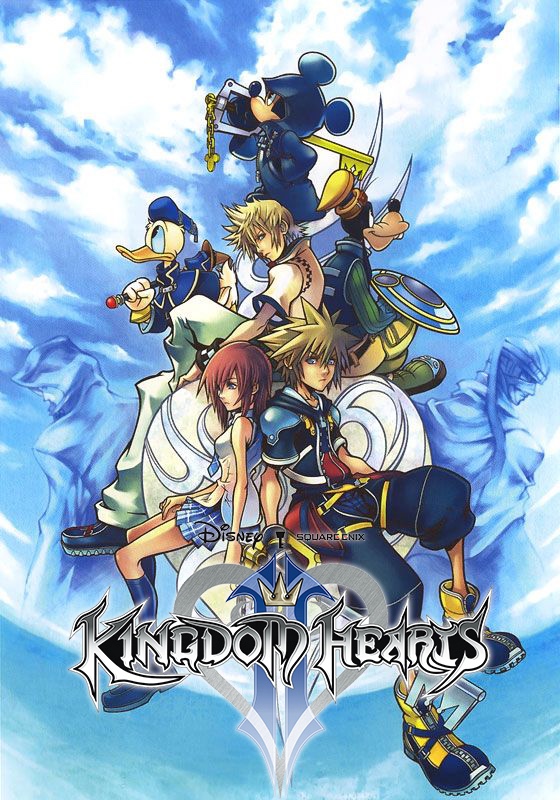
The third game in the series, has a “2” in its name. This game takes place a few years after the events of Chain of Memories. The beginning of the game follows Roxas. Players will play through the tutorial as Roxas. Once the tutorial is complete, players take control of Sora. The story starts off with the same premise as the previous two games. Sora, Donald and Goofy wake up after getting their memories restored (a lot of their memories are lost during the events of Chain of Memories) and two years has passed. Upon waking up, they set off to find the King and Riku, again. The game follows this plotline until they eventually do meet up with the game about midway through the story, where things start to get a bit complicated. But I’m not going to touch upon that since it does spoil the ending a bit.
The beginning of the game, as mentioned earlier, sees players take control of Roxas. Roxas plays similarly to that of Sora from the first game, with his attacks being very slow. This is a great way to ease players into the game, refreshing player’s minds with combat and controls reminiscent of the first game before throwing them into the new and must faster paced combat after they get a grasp on the controls. This is the only real compliment I can give the tutorial aside from the short and emotional storyline following Roxas. The tutorial is infamous for its incredible length, with players being able to complete this tutorial in 2 to 4 hours. The game as a whole is significantly longer than the previous two games. The tutorial sees players explore Twilight Town, a sandbox-like world to help introduce the games mechanics to the players. The problem is that the story, while being emotional, is very long and padded out with a lot of useless arcs. The story jumps around from Roxas and his friends trying to get money by doing odd jobs, entering a tournament, and doing their summer homework. Upon finishing the tutorial, players take control of Sora. Upon making your way through Twilight Town, now as Sora, players are introduces a new type of enemy known as “Nobodies”. The Nobodies are what remains of the husk left behind after a heartless steals a heart. Defeating both a heartless and a nobody restores the original heart. Organization XIII, the antagonists from Chain of Memories, return as a bigger threat.
The combat remains relatively unchanged from the first game, although its much faster and has vastly improved aerial combat. The drive gauge is also a new addition to the player’s arsenal. The Drive gauge is used when using the game’s new feature: forms. Sora’s forms will consume the drive gauge over the time spent in the form, and these forms give Sora new abilities limited to the forms which allows for more options when maneuvering around in combat. There are six forms in total. Valor form, which allows the player to dual-wield keyblades in addition to having a heavy emphasis on physical combat and allowing for extended/faster combos at the expense of the ability to use magic. The Wisdom form specializes in the opposite of the valor form, allowing Sora to skate around the ground and attack enemies at a range using magic in addition to allowing him to cast spells faster while also being able to power up the spells during combo finishers. The Limit form, should be noted that it is exclusive to the Final Mix version of the game and it uses magic and abilities from Kingdom Hearts and Kingdom Hearts Final Mix that didn’t originally appear in Kingdom Hearts II, such as the Dodge Roll ability. Master form is basically just a combination of Valor and Wisdom form, being equally balanced in both physical and magical attacks. Final form is probably the most satisfying form out of the rest. The form is obtained randomly after beating a certain boss near the end of the game and using a certain keyblade and hoping it randomly appears. The form gives players the “glide” ability in addition to making Sora play similar to Roxas (In Final Mix at least) from an earlier fight in the game. And then there’s the Anti form, which is a strange form in that it is a random occurrence when equipping a certain keyblade (similar to the Final form). Sora becomes much faster, but his attacks are weaker, and he takes more damage, making this form sort of a double-edged sword and hard to use effectively in certain situations. Once the form is activated, it consumes all of the drive gauge (note that other forms only gradually consume the gauge over time) and players cannot manually change him back until the battle ends or if they flee. The summons return from the previous title as well, also using up the drive gauge when activated in addition to using up party members. The summons this time consists of Chicken Little, The Genie, Stitch, and Peter Pan (With the help of Tinker Bell). The rest of the combat is relatively the same. It has a lot of improvements and removes and fixes some of the problems the first game had while introducing its own fun and new elements. But in addition to changes in combat between the first and second game, there’s also changes with exploration.
There are a lot more worlds to explore in this game with each one feeling unique and interesting. Some return from the first game, but a lot are brand new. There are a total of 15 worlds players will explore, and in addition to that, players will revisit some of these worlds a second time. The worlds this time are: Twilight Town (Kingdom Hearts), Hollow Bastion (Kingdom Hearts), Land of Dragons (Mulan), Beast’s Castle (Beauty and the Beast), Olympus Coliseum (Hercules), Disney Castle (Disney), Timeless River (Mickey Mouse), Halloween Town (Nightmare Before Christmas), Agrabah (Aladdin), Port Royal (Pirates of the Caribbean), Pride Rock (The Lion King), Space Paranoids (TRON), The World That Never Was (Kingdom Hearts), and two optional worlds being The Hundred Acre Woods (Winnie The Pooh) and Atlantica (The Little Mermaid). There is also a secret boss that is found in what could technically be considered another world, but it only consists of one room, that room being an arena.
All of these worlds are fantastic though. The only real complaint is that they’re a lot more linear when compared to the first game, in addition to some being much smaller. But the more linear design makes up for it with a lot of more interesting concepts and ideas that build off the original worlds from the first game and source material in a unique way. For example: the original Olympus Coliseum from the first game only had three rooms and was mainly used as a location to take on challenges, while in this game it has players explore the Underworld. Port Royal has you sailing a Pirate Ship (Not literally though, it’s only a menu) to get to different islands. Halloween Town has you explore Christmas Town. Agrabah has a bit more of the city to explore in addition to a revamped Cave of Wonders. The only bad world out of all of these is probably Atlantica, but it could be worse since its completely optional. They fixed the swimming mechanic to a degree, since there’s only one room that requires players to swim around. So that’s a net positive. But then the worst part of the world (which is the entire world) rears its ugly head. It is a rhythm game. One thing to note with this, is that Haley Joel Osment cannot sing, and he sings a cover of “Under the Sea”. And while there are some songs lifted from the original movie, the new songs made for the game are hilariously awful. On a slightly more positive note: The Hundred Acre Woods returns, once again having players collect pieces of the torn book and returning to unlock new mini games to play. But when it comes to the actual worlds and their level designs, there is a lot to love.
Twilight Town is absolutely fantastic, with its music and very homey feel. There’s a lot to explore here. There’s the town itself, a forest that leads to an abandoned mansion (you can also explore this mansion), an underground tunnel system that leads to almost all areas of the town, and an entire other portion of the town that you can explore if you hop on the train over there. In addition to all of this, there’s Yen Sid’s Tower, but there isn’t too much to this location, just sort of a fun addition.
Hollow Bastion returns from the first game, now undergoing a restoration effort to restore a town that was unseen in the first game. The area is home to a town area, a few cliffs outside the town, the castle returns but is limited in exploration, and in the Final Mix version of the game, there is the Cavern of Remembrance. The area is also home to a lot of characters from the Final Fantasy series, a lot of them returning from the first game in addition to some new. This is also where players will access the worlds “Space Paranoids” and “The Hundred Acre Woods”.
Land of Dragons isn’t too interesting of a world in level design but makes up for in its unique art style when compared to some of the other worlds. The world is very linear, with it feeling like a straight line from point A to point B at times. There is also the missions players will have to do when they first visit the world in order to progress through the story. These missions all mainly boil down to taking down Heartless with certain conditions.
Beast’s Castle is an okay world. Some like it, others don’t. There isn’t too much interesting in terms of level design, aside form one section where Sora must work with some of the servants of the Beast’s Castle to make their way out of the dungeon. The setting is interesting, and that’s really the extent of it, just a decent world.
Olympus Coliseum is pretty cool. The surface is still pretty boring, once again only being three rooms, until the Underworld comes into play. Similar to Beast’s Castle, the level design isn’t anything special. But it makes up for it with it’s improved tournaments. The first few tournament cups aren’t anything too special, aside from a few interesting gimmicks that help give the cups a little extra challenge (Ex: No drive gauge, no party members, etc.) But then there’s the Hades Paradox Cup. This cup consists of 50 rounds with a restriction changing every 10 rounds. Players are expected to complete the entire cup without dying. If players do die, then it results in them having to start the entire cup all over again from round 1. Players will fight through an onslaught of heartless and nobodies, but every now and then, there will be a special fight against certain characters. Some of these characters include Cerberus, Pete, Yuffie, Tifa, Leon (a.k.a Squall from Final Fantasy VIII), Cloud (sporting his outfit from the Advent Children movie), and Hades himself. But other than the tournaments, it’s an okay world.
If Disney Castle is to be considered its own world separate from the Timeless river world, then its terrible. The world only consists of a few rooms, with the only interesting part being where players are tasked with escorting Minnie Mouse safely to the throne room while fending off against hordes of heartless. Similar to Space Paranoids and The Hundred Acre Woods having to be accessed in Hollow Bastion, Timeless River must be accessed through Disney Castle. The Timeless River world features Sora taking on a more cartoonish appearance in addition to being black and white, with Donald, Goofy, and Pete all taking on their original designs from their old cartoons. The area is an amalgamation of various classic Mickey Mouse cartoons. There is the main area that is inspired by the “Steamboat Willie” cartoon, with the area featuring other classic Disney cartoon characters like Horace Horsecollar, Clarabelle Cow, Clara Cuck, and Captain Pete. There are other areas based on other cartoons as well and throw Sora into a variety of different scenarios. There are four windows, each leading to a different area of the past. There’s the “Building Site” which is based off of the short titled “Building a Building” from 1933. The area is a construction site with a rickety platform that can launch both the player and heartless into the air. Then there’s Lilliput, a miniature town based on the short titled “Gulliver Mickey” from 1934. The area has a big canon that players can activate by jumping on it. Doing so will cause the canon to fire and hit any heartless caught in its range. Next is the “Scene of the Fire” which is based on the 1930 short named “The Fire Fighters” and the 1935 short titled “Mickey’s Fire Brigade”. The area features a big building set on fire. And lastly, there’s “Mickey’s House” which is based on the short from 1931 named “Mickey’s Orphans”. This takes place inside Mickey’s house. When discussing the two worlds as one world, it’s pretty fun. When discussed as separate worlds, both fall flat, more so Disney Castle.
Halloween Town is really fun. This time you explore not just Halloween Town, but also Christmas Town. The world ends up feeling pretty small because of this. Only the entrance, graveyard, and town square can be explored in Halloween Town. Then there’s the Hinterlands which leads to Christmas Town. In Christmas Town, there isn’t much more to explore either. There’s Yuletide Hill (the entrance of Christmas Town) Candy Cane Lane, one small room that features a save point in Santa’s factory in addition to two other rooms in the factory and a boss arena. Still a fun world to come back to though.
Agrabah is a decent world. There isn’t really anything too interesting besides a small area in the Cave of Wonders and larger city area. Just an okay world.
Port Royal is a strange world, mainly due to the clashing art styles between Sora, Donald and Goofy, and the cast of the Pirates movie. Its still a fun world to explore though. The theme from the Pirates of the Caribbean movies even plays when in combat. There’s also the unique gimmick of being able to choose which islands to go to. Just an overall fun world. Pride Rock is also just an okay world. It’s fun being able to play as Sora, but now with a slight difference in his moveset, but the world itself isn’t as interesting when compared to the others.
Space Paranoids is also a decent world, though the unique visuals from TRON help make up for it being a bit of a boring level to explore.
And then there’s the World That Never Was. Like Hollow Bastion being a great final world and being an overall just plain cool location to explore. From the dark city you start out in to the giant towering castle you scale, the world is amazing in its design. It may not test the player’s skills as well as the Hollow Bastion from the first game, but simply its design and the segments of the story that unfold here are what makes it such an amazing world, in addition to the final battle.
Of course, there is still things to do after beating the game. Some aren’t as interesting as others, but there’s still things to do. Obviously, there’s the optional worlds players can choose to explore if they want. Players can go back and try to get better scores on minigames and challenges. Collect the various puzzle pieces scattered throughout the worlds and putting them back together. Synthesizing the Ultima Keyblade. Maxing out all summons and drive forms. Completing the various Underdome cups. Reach max level. And more. There is also the gummi ship missions that return, now with the action sped up significantly. It feels slightly more fun to make your own gummi ships in this game compared to the first, and the missions themselves are really fun to play and don’t feel like an annoyance like they were in the first game.
There is also the Final Mix changes and additions. Things were added such as a new difficulty known as “Critical Mode”, an extra harder difficulty. Some textures were redone with better quality and some animations were changed. A new drive form known as “Limit form” was introduced and exclusive to the Final Mix version of the game. A new collectable was added known as puzzle pieces, and upon collecting the puzzle pieces, players will have to solve the puzzle and complete the picture. New cutscenes were added, these new cutscenes mainly focusing on Roxas and Riku. A new late game boss is added into the story in addition to rematches against the Organization XIII members that only appeared in Chain of Memories are now included in form of “Absent Silhouettes”. There is a total of 5 Absent Silhouette fights. A new challenge is added in the form of duels that double as minigames against a new type of heartless known “Mushroom XIII”. In Hollow Bastion, a new section is added known as “Cavern of Remembrance”. The area includes new and very difficult heartless and nobodies. Upon making it to the end of the area, players are able to rematch any member of Organization XIII, but each fight is made significantly more difficult. A new boss fight against an enemy known as “Lingering Will” is included and has been dubbed by the community as the most difficult fight in the entire game. A theater mode is now included, allowing players to rewatch cutscenes. A new secret ending titled “Birth By Sleep” has been added, teasing the next game. Crowns can now appear on Sora’s head for accomplishing certain feats in the game. These feats include: getting the proper score on all Mushroom XIII duels, defeating all the rematches against Organization XIII in the Cavern of Remembrance, and defeating the Lingering Will. New weapons, armors, and accessories have been added. There are also other miscellaneous changes made, such as scaling the difficulty during certain battles and events. There is also new costumes for Sora, Donald and Goofy for when they go into Christmas Town and new music is added for the area as well.
And while on the topic of this game’s music, the soundtrack here is incredible, and probably the most memorable one out of the entire series. There’s too many great songs like “Lazy Afternoons”, “Tension Rising”, “The 13th Struggle”, “Roxas”, “The Afternoon Streets”, “Working Together”, “Waltz of the Damned”, “Rowdy Rumble”, “Deep Dive”, “A Fight to the Death”, “What a Surprise?!”, “Happy Holidays!”, “The 13th Reflection”, “Cavern of Remembrance”, “The Other Promise”, and “Rage Awakened” are all absolutely amazing. Familiar Disney songs also make appearances, some of these include: “Beauty and the Beast”, “Mickey Mouse Club March”, “Winnie The Pooh”, “Part of Your World”, “Under the Sea”, “He’s a Pirate”, and “This is Halloween”. There is also the new opening theme “Sanctuary” by Hikaru Utada, which is also really good. The voice acting is also still great, with the cast of the original characters reprising their roles in addition to some of the veteran Disney actors returning. Jesse McCartney does a brilliant job at portraying Roxas. Robin Atkin Downes as Luxord is a big highlight. Kirk Thornton also does a great performance as Saïx. Cristopher Lee makes an appearance in this game as the character DiZ, which is great yet strange. Paul St. Peter does an absolutely amazing job delivering a menacing performance as the main antagonist. And there’s James Patrick Stuart as Xigbar, an absolute legendary performance that sticks throughout the rest of the series. Overall, a solid cast. And a solid game in general.
This is probably one of the best entries in the entire series. It has some of the best combat, the best worlds, awesome extras, and a great story. This right here, is how you do a sequel.
Kingdom Hearts: 358/2 Days
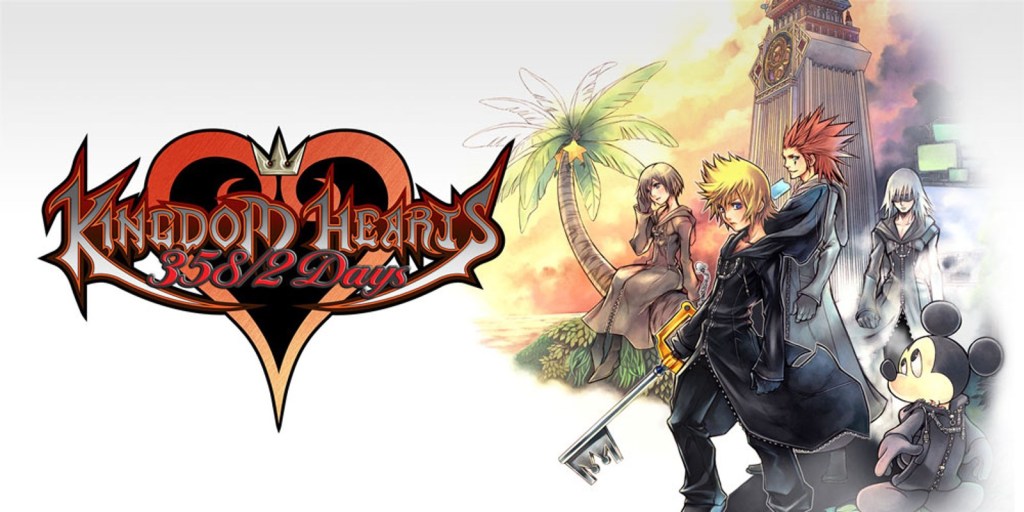
This game has the first of many titles that are guaranteed to be the death of me someday. The title: 358/2 days makes sense when actually looking at the story in retrospect, being that it’s story about 2 characters taking place over the course of 365 days. But it doesn’t change the fact that this title is awful. The title is also canonically pronounced: “Three-Five-Eight Over Two Days” on the official advertisements. The game is a prequel to Kingdom Hearts II and takes place during the events of Chain of Memories. The game focuses on Roxas, who is taken in by Organization XIII as its thirteenth member and is vital to their plans as he’s able to wield a keyblade and help in their goal of summoning Kingdom Hearts by defeating the heartless and freeing the hearts. The story also follows a new character, a secret fourteenth member of the organization named Xion. The story mainly follows three characters: Roxas, Axel, and Xion and the friendship the three have together. This is really the whole story and it never really changes, most likely due to the fact that this is a prequel. Though certain members of the organization do disappear over the course of the plot to head to Castle Oblivion, which is a pretty cool reference to the events of Chain of Memories.
Similar to Chain of Memories, the combat is very different from the mainline games, though it doesn’t deviate as much as Chain of Memories did. It was originally released on the DS, which makes it somewhat impressive that they were able to pull off a combat system that takes place in a 3D space, considering most DS games where on a 2D plane. The main difference here is the magic system, being that its completely gone. In Kingdom Hearts and Kingdom Hearts II, players would use MP to cast spells from their magic menu in real time. You can still cast spells in real time, but it doesn’t consume MP. Instead, the MP system has been replaced with a “panel” system. Players can equip the panels of the spells they want to use right before each mission. In addition to this, spells from previous games have also been changed. The most drastic change is with the different tiers of spells. In previous games (And in other rpgs) spells were divided up into tiers. For example, there’s Fire, Fira, and Firaga. Each one is stronger than the last, but it would consume more MP. In this game, the tiers are completely gone. Instead, Fire, Fira, and Firaga are all completely different from one another, which gives more incentive to use each one. There is also the new addition of “Limit Breaks”. Limit Breaks can trigger by pressing the “A” button on the DS when a character’s health makes it to the yellow area of the health bar. A powerful spell is casted when this is done. This is all just the general combat though. There are two types of modes that are available to play. The first is Mission Mode. Mission Mode is basically the main story, and involves players with going around completing various tasks for the organization, sometime with story thrown in. Accompanying players on these tasks are some of the members of Organization XIII, who serve as party members for specific missions. These missions can range from doing something like taking one or a group of heartless to investigating the landscape of various worlds. This type of gameplay can seem monotonous to some but is still a smart decision when it comes to the device it was made for. The DS is a portable system as we all know and can be played in short bursts. Naturally this game would take advantage of that with a mission structure. You can do a few missions on a bus ride somewhere, then save your game and do a few more missions later. The main issue with this though, is that the game is 40 hours long, which means at least 40 hours’ worth of doing the same kind of missions over and over again. The second mode though, is the Multiplayer. There are 13 character playable at the start, with 6 unlockable characters. The 13 playable characters are: Xemnas, Xigbar, Xaldin, Vexen, Lexaeus, Zexion, Saïx, Axel, Demyx, Luxord, Marluxia, Larxene, and Roxas. Roxas can also duel-wield keyblades if he has a certain item equipped. The 6 unlockable characters are: Xion, Riku, Donald, Goofy, King Mickey, and Sora. The multiplayer mode is also non-canonical and separate from the main story. You can play with up to 4 players and is set up in a mission structure. Players can either play cooperatively or competitively. The game also had a chat feature for communication between players. Obviously, the Nintendo Wi-Fi service has been shut down in recent, making it hard to play this mode with others. Luckily though, you can also play this mode without other people, instead you can play with AI controlled partners. I can confirm though, from what I played of this mode before the Nintendo Wi-Fi service was shut, it was pretty enjoyable. Sometimes I find myself returning to it once in a blue moon to play a few games against the CPU. I mainly had more fun with the competitive mode then the cooperative mode. But yeah, A lot of fun was had when played with others, but CPUs can’t really replace the fun of getting together with another human being and playing it together. It’s not really a loss that I’ll lose sleep over though, but I would like to see something like this done again in the future.
Then there are the various worlds included in this game, and where you’ll find yourself exploring limited sections of due to the mission structure. These worlds are: The World That Never Was (Kingdom Hearts), Twilight Town (Kingdom Hearts), Agrabah (Aladdin), Beast’s Castle (Beauty and the Beast), Olympus Coliseum (Hercules), Halloween Town (Nightmare Before Christmas), Wonderland (Alice in Wonderland), and Neverland (Peter Pan). There was a scrapped Pinocchio world as well, but it was cut do to space restrictions on the DS. The director, Tetsuya Nomura, stated that it would’ve been based off of Prankster’s Paradise from the original film and be set in a circus and the story would’ve played off of Pinocchio as he’s a puppet with no heart and the nobodies also possess no heart. But in terms of exploration for the worlds actually in the game, there is none. You are restricted to the areas of the world that the game wants you to stay in. The areas per worlds change depending on what the mission is. Exploration doesn’t really matter though since all the locations are ripped from their original counterparts (the only exception to this is Neverland, as it takes place on the actual islands).
There was also a movie version of the game that doesn’t really make for a great movie. This movie is included in the Kingdom Hearts 1.5 ReMix collection. It basically takes all the static cutscenes told through dialogue boxes in the original game and transforms them into cutscenes. The movie also has these boxes of text that appear from time to time which is strange since they could’ve animated the parts, but they didn’t, instead opting for text for the audience to read. There are also strange cuts in the movie, as none of the fights are actually animated, causing these weird cuts.
This game is completely necessary to the overarching story of the series. The game doesn’t really do much besides show off a bit more of the politics of Organization XIII and to help make the end of Roxas’ section in Kingdom Hearts II even more sad. Give this game a try if you’re curious, if not, then just watch the movie in small bursts since its 3 hours. The game isn’t bad, but its nothing too special when compared to the others.
Kingdom Hearts: Coded/Re:Coded

Probably one of the most unnecessary entries in the entire series. The game’s story literally only exists to explain the ending of Kingdom Hearts II in addition to tying the game to Birth By Sleep.
The game was originally released as a puzzle game on mobile phones and was told episodically. The final episode was not released until after the release of Birth By Sleep, potentially to not spoil how that game ends. This was only released in Japan, though a DS remake titled “Kingdom Hearts Re:Coded”. The game’s plot revolves around King Mickey, Donald, Goofy, and Jiminy Cricket trying to organize the entries of Jiminy’s journal until they discover a message that Jiminy never wrote that states “We must return to free them from their torment.” In order to investigate the message, Mickey digitizes the entries of the journal, thus creating a data version of Sora, who goes to find out who “them” is.
The game is very simple, with the goal being to destroy heartless in a world in order to progress the story. A new addition to the game are “Bug Blox”, which is used to solve various puzzles throughout each world. Each world also sees players in a different gameplay style. And then there’s Kingdom Hearts Re:Coded, the remake released on the DS. This game uses the same engine as 358/2 Days and is largely the same as its mobile counterpart. One big change is the game’s implementation of the deck system, which was originally unseen in the mobile version. The deck system was originally used in 358/2 Days and was later again reused in Birth By Sleep, before being added to this game. There is also the “Matrix System” which allows players to customize their stats, gear, and commands for their command deck.
Exploration in these worlds are largely the same as the worlds original appearances, just with puzzles that need to be solved in order to get rid of the “glitches” present each world. The worlds that can be explored are: Destiny Islands (Kingdom Hearts), Traverse Town (Kingdom Hearts), Wonderland (Alice in Wonderland), Olympus Coliseum (Hercules), Agrabah (Aladdin), Hollow Bastion (Kingdom Hearts), and Castle Oblivion (Kingdom Hearts). As mentioned earlier, each of these feature a different style of combat. For example: Traverse Town has 2D side-scroller stages, Wonderland is rail-shooter obstacle course, and Olympus Coliseum has a turn-based rpg system.
Then there’s the version that was released in the Kingdom Hearts 2.5 ReMix collection. This got the 358/2 Days treatment, as it is not a game in this collection, but rather a movie. Unlike 358/2 Days though, this game’s story is even as enjoyable or engaging as 358/s Day’s story, as most of it is a retelling of the first game’s story. The only reason this game exists is to explain what was written in the letter Sora receives from King Mickey at the end of Kingdom Hearts II, teasing Kingdom Hearts III. Only play the game if you’re really interested, and only watch the final cutscene of the movie in 2.5 ReMix collection, since that’s the only part of the game that even matters.
Kingdom Hearts: Birth By Sleep/Birth By Sleep: Final Mix

“A prequel entry released for the PSP. Genius, it’ll sell millions.” is what Tetsuya Nomura thought when making this game. As mentioned, this is a prequel game that takes place before the first game and focuses on three keyblade wielders, Aqua, Terra, and Ventus. Similar to the DS, the Playstation Portable was a portable system made by Sony. Because of this, the game was made to be played in small bursts, causing the game to take the same approach as the mainline games, implement the command deck system from 358/2 Days, and make the worlds only take around 30 minutes or so to complete. Of course, the game would be too short if each world was only 30 minutes, so they decided to pad it out by making 3 different playable stories, each one focusing on each of the main protagonists. Each protagonist’s story takes at least 15 hours to beat, making the entire game’s run time equal roughly around 45 hours, without including things like deck editing, retires, minigames, and other things.
The game mainly sets up Sora’s origin and the main antagonist of the series’ origins, Xehanort. The story begins with the three protagonists, Aqua, Terra, and Ventus in the Land of Departure as Aqua and Terra are getting ready for their “Mark of Mastery Exam”, a test that allows a keyblade wielder to graduate into a keyblade master if the exam is completed successfully. During Aqua and Terra’s exam, Master Xehanort sabotages the exam, causing Terra to be deemed unfit to become a keyblade master and Aqua passing. After this, a group of enemies known as the “Unversed” start appearing mysteriously after Xehanort disappears. Terra is sent to destroy the Unversed and find Master Xehanort, with Ventus following Terra and Aqua being dispatched by Master Eraqus to keep track of Terra.
As mentioned earlier, the story is split up between the three protagonists. Luckily, the game has its own timeline to help show when and where each character was at during the events of the story, allowing players to keep track of what’s happening.
After completing the tutorial and Terra being sent off, the player must choose which protagonist they want to play the game as. Terra specializes mainly in physical combat but is weak in magic. Magic is Aqua’s strong suit with the downside to her character being physical combat. And then there’s Ventus, who serves as a nice middle ground. I would personally recommend playing as Ventus first, Terra second, and Aqua last, though it doesn’t matter the particular order. The game needs to be beaten three times, each time as a different character. Player’s can switch to another character at any point in the story.

Combat is relatively the same as mainline entries, but now includes the deck system from 358/2 Days in addition to a new mechanic allowing players to fuse their commands and make new and more powerful ones. The game features Deck Commands, Commands Styles, and the Shotlock. Deck Commands are the replacement for spells in this game. Upon using one of these commands, the command will go into a cooldown for a period of time. Command Styles are activated after the player lands a certain amount of hits on enemies using a certain type of command. After the player fills the Command Style meter, the character they’re playing as enters a state that is reminiscent to that of the form changes from Kingdom Hearts II. Each of these Command Styles can change how the character plays when in combat drastically for a short period of time. Depending on the commands used can alter what Command Style players will be thrown into. The Shotlock is another new addition, testing player’s precision and accuracy in a short timeframe to lock onto various enemies. Once the enemies have been locked onto, a powerful attack is unleashed, making it great for crowd control. Each shotlock is unique for each character. Summons make a return from Kingdom Hearts and Kingdom Hearts II, but Birth By Sleep adds a new spin on the mechanic.
Introducing: “D-Links”. The D-Link (short for “Dimension Link”) is the game’s new take on summons from previous titles. The D-Link will temporarily grant the player new and unique powers of a specific character for a short period of time. Wireless D-Links were also an option. This would allow for a player to connect with a friend’s PSP to summon their character. Each of the three protagonists have D-Links with different characters from one another. For example, while Aqua and Ventus have D-Links with Snow White, Terra has a D-Link with Maleficent. There is also a multiplayer mode known as “Arena Mode”. This mode allows for 3 players to battle against the Unversed together. After the battle, each player will be ranked. Certain commands and items can only be used while in this mode. It should also be noted that if you’re playing the Final Mix version of the game in the Kingdom Hearts 2.5 ReMix collection, the online multiplayer mode doesn’t work, thus making some of those items completely useless.
Exploration is also limited in this game, mainly due to it being a portable game. There are 11 worlds to explore. These worlds are: Land of Departure (Kingdom Hearts), Dwarf Woodlands (Snow White and the Seven Dwarves), Enchanted Dominion (Sleeping Beauty), Castle of Dreams (Cinderella), Keyblade Graveyard (Kingdom Hearts), Radiant Garden (Kingdom Hearts), Mysterious Tower (Fantasia), Disney Town (Disney), Olympus Coliseum (Hercules), Deep Space (Lilo and Stitch), and Neverland (Peter Pan). None of these worlds really have too much to them but are still somewhat memorable in design and layout. Land of Departure serves mainly as a tutorial area.
Dwarf Woodlands is interesting in that certain characters access certain parts of the world. Terra explores the Evil Queen’s castle, Ventus explores the woods, and Aqua explores both.
Enchanted Dominion is a decent area. There isn’t too much in the world that stands out. Aqua has a pretty cool section that involves teaming up with Prince Philip. But other than that, nothing else is too memorable aside from the scenery.
Castle of Dreams is pretty cool. Terra and Aqua get explore the Castle and courtyard, but there sections aren’t as cool as Ventus’, which sees him getting shrunken down to a size similar to the mice in the original film and help gather parts for Cinderella’s dress. Ventus even gets the chance to fight that cat, Lucifer, from the original film, which is a pretty unique idea for a boss.
The Keyblade Graveyard is an interesting location, but not really until the end of the game. It serves mainly as a boss arena earlier in the game but becomes an actual world near the end. There’s a section of the world that features some pretty annoying tornadoes that throws players into random fights with enemies if they get caught in them. But these tornadoes can be avoided. And then there’s the field filled with the keyblades of the fallen from the war, which is a pretty cool location when you first see it coming into view from far away. The world as a whole, while not as visually appealing as other endgame worlds like Hollow Bastion or The World That Never Was, it still does feel like a location that is perfect for the climax.
Radiant Garden has a cool concept, being that its what Hollow Bastion used to look like years before it became Hollow Bastion. The world itself isn’t anything special though, as its only a few rooms and none of the rooms really have anything interesting too them.
Mysterious Tower is a bit of an odd world. Mysterious Tower was originally just another location that was a part of Twilight Town in Kingdom Hearts II, but it’s now its own world in this game. Its even stranger since they made the location significantly smaller, removing the many staircases and individual rooms that were present in the original. This is basically a “nothing” world and really only exists to extend the plot.
Disney Town is sort of the game’s replacement for the Hundred Acre Woods world from previous titles. This world primarily features minigames, though unlike the Hundred Acre Woods, there’s actual locations to explore and these locations are filled with enemies. There’s the main festival area, the sewers, and even this strange pinball area. The mini games here consist of a rhythm game, a game of volleyball, and a Mariokart clone.
Olympus Coliseum has the same set up as the original Kingdom Hearts game now, with the world only consisting of a few rooms and serving mainly as a gauntlet. You just beat up a couple of enemies in a match and then move on. There isn’t much here aside from Zack from Final Fantasy VII: Crisis Core randomly showing up.
Deep Space was an interesting world. This world is based off of the ship where Stitch was held captive in the original film, which makes it interesting to explore since you didn’t really see much of the interior of the ship originally. There’s a section that involves turning off the gravity which makes your jumps floatier. There’s a weird beyblade section where players take their keyblades and turn them into vehicles as they knock out enemies outside the ship. Unfortunately, the world has one minor problem that it shares with “Monstro”. That problem being that areas can look similar at times. Granted, it isn’t as bad here as it was in Monstro, though it can still be a tad bit confusing at times. There are many more interesting rooms with different designs and details to help players figure out where they are in the ship.
And then there’s Neverland. Similar to 358/2 Days, it takes place on the actual islands rather than Captain Hook’s ship. This world is similarly decent, as it isn’t too interesting, but it isn’t too tedious either. Just a solid and entertaining world, though it probably is the most fun when it comes to actually exploring a world, due to how it feels a lot bigger when compared to the other worlds.
And then, of course, there’s still more things to do in this game. One example, is the fortune street-like minigame known as “Command Board”. And if you thought the Hundred Acre Woods was missing completely from this game, then you thought wrong. If you don’t want to be a real gamer and level up and get stronger the normal way, then you can play this monopoly clone. You’ll land on squares that house special prizes in most cases. These prizes (most of the time) end up being new commands for your command deck. You can choose a board layout based around one of the worlds present in the game, in addition to the Hundred Acre Woods, and you’ll compete against the characters from that original world. This game also supports multiplayer (but good luck finding someone who’d want to play it with you). There’s also the minigames I mentioned earlier found in Disney Town. They’re fine, nothing special about them really, and you probably won’t want to replay them either unless you want to 100% the game (but you’d enjoy hell better than doing that). You can go to the mirage arena and participate in fights either alone or with friends. There are collectibles that you go back and get. And then there’s the surprisingly entertaining mechanic that involves fusing commands to create even more powerful ones.
And there’s also the addition of the Final Mix version, which was included in the Kingdom Hearts 2.5 ReMix collection. The big change this version introduces is the ending. Originally, if beat the game with all 3 characters at a specific difficulty, you’d unlock a secret cutscene. The Final Mix version of the game though, lets you play the cutscene! That’s right. They take the cutscene and let players play through it as if it where an extra, albeit still, short world. Obviously, this isn’t the only thing this version adds. It adds a couple of new secret bosses in addition to one of the most unfair bosses in the entire series known only as “Mysterious Figure”. The game also introduces a few new commands, new bosses appear in the Mirage Arena, and there were also a few other minor changes.
The soundtrack and voice acting is also, as always, top notch. The only complain when it comes to voice actors is certain moments that Terra is portrayed, in addition to Aqua sounding lifeless at times. But still, Jesse McCartney does a good job playing Ventus. Haley Joel Osment takes a break as Sora for this title and kills it as one of the antagonists of the game, Vanitas. Leonard Nimoy brings a menacing performance as the game’s main antagonist, Xehanort. And Mark Hamill delivers a great performance as Master Eraqus (Fun fact: If you couldn’t figure it out, his name is an anagram of “Square”, after the publishers “Square Enix”). The soundtrack also deserves some praise as it features some great songs like “Future Masters”, “Mkaukau?”, “Neverland’s Scherzo”, “Unbreakable Chains”, “Rage Awakened -The Origin-”, “Dismiss”, “Master, Tell Me the Truth”, and more.
The game can be really fun, and depending on who you ask, can also be considered the best in the series. Playing this on the PS4 feels strange due to the worlds being so short, but it makes sense when you consider the hardware it was originally released on. It should also be noted, and this is a major note, that the Final Mix version that was bundled in the 2.5 ReMix collection does not have multiplayer. So despite the game actively promoting it in tutorials, it doesn’t work. So that sucks, I guess. But the game is still a vast improvement in quality unlike the DS entries that came before it. I would say that this game is definitely worth more of your time than the DS entries. And a little tip: don’t try to 100% the game. Just trust me when I say that it isn’t worth it.
Kingdom Hearts 3D Dream Drop Distance/HD Dream Drop Distance
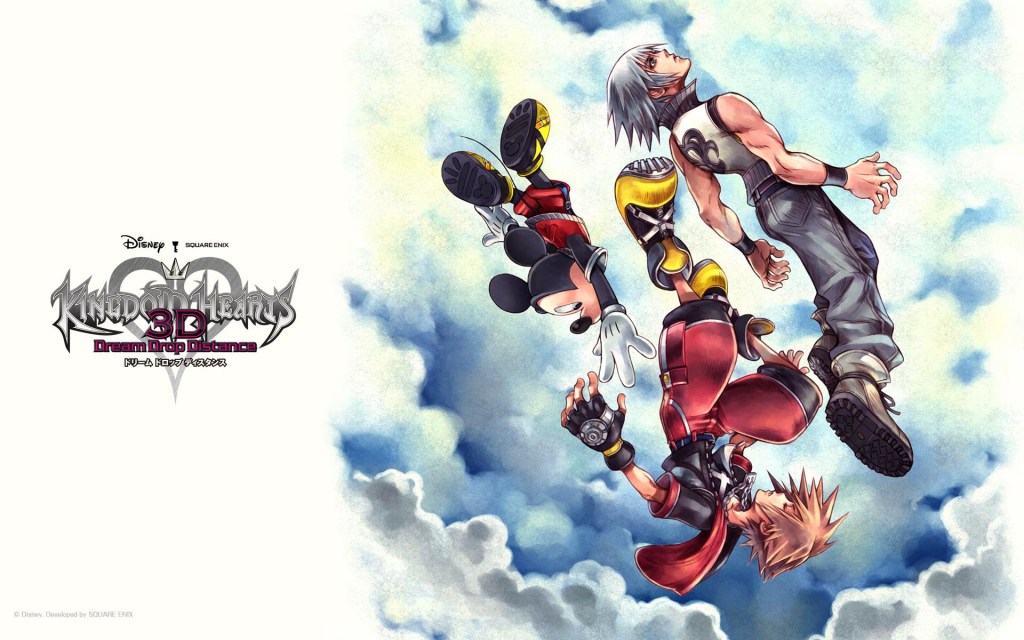
(Just a bit of a heads up: I talk about the bosses of this game. I did not talk about the bosses for previous game due to how many there are in each. I may have touched upon the secret bosses and super bosses for some games, but I cover the actual mandatory boss fights. The reason I cover these bosses is because they’re a lot easier to cover in this game with the added bonus of there not being as many as others. There is a warning right before I talk about each boss, I won’t talk about any of the final bosses of the game aside from one. So this is just sort of a heads up in case you don’t want spoilers for that kind of thing.)
And now we’re at one of the more controversial games in the series. Its controversial for a multitude of reasons, but I would just recommend playing it for yourself and formulating your own opinions on it. This is where the series truly started to get confusing. If you thought the plot twist that was revealed in Kingdom Hearts II was confusing, then you haven’t seen anything yet. But regardless of how confusing the story is, the summary is pretty simple. The story revolves around Sora and Riku taking the Mark of Mastery exam in order to become Keyblade Masters and stop Xehanort’s return. Their exam involves them being put into a deep sleep, separated from each other, and tasked with reawakening the seven “sleeping worlds”. The “sleeping worlds” are all worlds that were destroyed by the heartless. And that’s the basic summary of this game without getting into some of the “other” shenanigans the game pulls.
You know the drill at this point: combat is the same as previous games. This game uses the command deck system from Birth By Sleep rather than the MP system like the first and second game. Although, there are three new mechanics introduced. “Dream Eaters”, “Flowmotion”, and the “Drop Gauge” (more on that later). Let’s start with the Dream Eaters. Dream Eaters are both your enemies and your friends in this title. There are “Spirit” Dream Eaters and “Nightmare” Dream Eaters. Try and guess which one is your enemy. The “spirits” basically serve as your party members, and you can equip up to three of them per character. Players obtain spirits by gathering specific items and creating them through those items. Players can also find recipes that allows them to create specific kinds of spirits. And thanks to the Nintendo 3Ds’ bottom screen, you can play with them using the stylus. And then there’s “Flowmotion”, by far one of the best mechanics the series has introduced to date. Flowmotion is a new type of action that allows for more fast-paced action and movement. It allows players to move quickly about by letting them bounce off of walls, grind on rails, or spin around poles. Flowmotion is also very useful in combat as well, and it can even break the game at times. Its incredibly fun to control and makes the simple action of moving around fun. And if you thought the dual-screen function of the 3Ds was only useful for playing with your virtual pet, then think again. The bottom screen of the 3Ds is also used in combat. Introducing the “Reality Shift” a gimmick made for this game exclusively that involves players swiping down on the bottom screen when a symbol appears above an enemy and forces them into something sort of like a minigame to deal damage in ways that vary. Some of these ways involves taking the enemies and slingshot them into each other, building a rail that connects them all to each other, swiping a specific direction in various comic book panels, and even playing a short rhythm game. This sort of helps add extra variety to the combat, but they’re not essential, so plyers can use them if they want to or they can completely ignore them. I also mentioned earlier that “you can equip up to three spirits per character”. That’s right, there are two playable characters in the game. This game sees the return of Riku as a playable character after being absent ever since Chain of Memories (he was playable in 358/2 Days, but only in the multiplayer and he had to be unlocked. So it doesn’t count). Both Sora and Riku play differently enough from one another, but this isn’t like Chain of Memories where they have completely different game styles from one another. Each character has some specific commands that are exclusive to them, so that adds a bit of variety to them. But, in addition to the return of Riku, we also see the new mechanic of “links”. Players can “link” with their spirits and depending on the spirit or combination of spirits, it will affect how either Sora or Riku plays. This acts similar to that of the Command Styles from Birth By Sleep. This changes how the character plays for a limited amount of time before reverting back. The affects and how each character can change depending on the spirits or combination of spirits used.
And then there’s the “Drop System”. This system is absolute hell. In summary: the game makes you play as two characters, Sora and Riku. There is a meter known as the “Drop Gauge”. Once the meter runs out, the game will make you switch characters right there on the spot. The problem here is that it always seems to happen at the worst possible moment. You could be in a boss fight and right before you defeat it, the drop gauge runs out and you’re forced to play as the other character, Once that character drops, then you’ll switch to the other character only to realize that you have to start the boss you were previously fighting all over again. This is the only big problem of the game, as it is a prominent feature that can get annoying very quickly. There are items that can stop the drop gauge from lowering, but it’s still annoying since an item slot now has to be dedicated to this item when it can be used for something better. Granted, this does make more sense when the original system the game was made for comes to mind. The 3Ds was a portable system, and like other portable systems, it is primarily played in short bursts. So you play for a bit, you drop, you take a break. Simple like that. Though its inclusion on the PS4 in the 2.8 Final Chapter Prologue Collection makes this inclusion more annoying than it was on the 3Ds as you’re typically not playing in as small bursts on PS4 than you are on 3Ds.
I guess one more thing I should talk about before moving on is the “hitstun” in the 3Ds version of the game. I’m pretty sure almost everyone knows about the concept or mechanics of hitstun, even if they’ve never heard the name before. For those who don’t know, hitstun is something that can be found in almost every action game and it isn’t even limited to the action genre (Ex: Fighting games). Basically if you hit an enemy, they temporarily recoil back, making it impossible for them to do anything in that short timeframe. This allows the player to string together combos or chain attacks together. The same rule can also apply to the player, with enemies able to do the same thing to the player. The hitstun in the 3Ds version of the game is unbalanced as the short timeframe usually present isn’t here, meaning that while most enemies may take damage from your attacks, its difficult to preform a basic series attacks without getting knocked away. Enemies aren’t stunned as easily from the player’s attacks, though they can still stun the player easily with their own and land attack after attack after attack. This isn’t as noticeable at first in the game, but in later portions of the game, near the end of the game more specifically, it becomes a lot more apparent. This is fixed in the PS4 port of the game in the 2.8 Final Chapter Prologue Collection, so yeah. Just thought I’d mention that since that really can impact the difficulty of this game significantly.
Though with the small rant aside, the game has my personal favorite form of exploration in the series. Before I list the worlds though, I should touch on the means of transportation to these worlds. The Gummi Ship from the first and second doesn’t return, but we instead get an entirely brand-new system to transport. Tis is known as “Dive Mode” which sees players playing as either Sora or Riku as they dive straight down and avoid obstacles. It’s pretty mindless and there isn’t too much to it. But yeah, that’s the mode of transportation between worlds and that’s really all there is to it. With that out of the way, the worlds this time consist of: Traverse Town (Kingdom Hearts), La Cité des Cloches (Hunchback of Notre Dame), Prankster’s Paradise (Pinocchio), The Grid (TRON Legacy), Country of Musketeers (The Three Musketeers), Symphony of Sorcery (Fantasia), and The World That Never Was (Kingdom Hearts). Destiny Islands (Kingdom Hearts) also makes a cameo during the tutorial of the game, which is pretty nice.
Traverse Town was an absolute delight to see return. The world also serves as the tutorial area for a lot of the game’s new mechanics. It probably isn’t the best world to show off the flowmotion system though, as some of the locations that return from it’s original appearance feel a lot more claustrophobic and not very ideal to preform flowmotion actions in. This is only in certain areas though. The world also feels a bit off, and that is mainly thanks to the addition of the flowmotion mechanic. Due to flowmotion, a lot of the level design is made to be a lot less linear than the worlds from previous games and feel a lot bigger and more open. And the new areas in Traverse Town are made to be a lot bigger to help give a lot more breathing room when using the flowmotion. This leads to the world looking visually a bit strange, as you’re in the shopping district in one area only to go through one of the doors and knows there’s these big huge walls you couldn’t see in the shopping district before. This doesn’t necessarily ruin the feel of the world though; this is still Traverse Town, which means it still is good. But its made even better with the addition of characters from “The World Ends With You” (A 2007 DS game directed by the same director of the Kingdom Hearts Series. It’s available on DS and Nintendo Switch with a sequel that released not too long ago and an anime that covers the events of the first game). Their inclusion doesn’t affect Traverse Town much, there more so there just for narrative purposes, such as explaining how Sora and Riku are now separated via parallel universes. There’s a few little references to their original game though, such as graffiti scattered throughout some of the walls of the area that relate to their source material. Aside from them though, the new areas are pretty cool. There’s this big underground Post Office located underneath letterbox. The new additions of the fourth and fifth district are pretty cool, with the fourth district featuring a large area with a lot of tall buildings, a giant coliseum, and a fountain. And fifth district really just serves as a cool-looking boss arena. Before I move onto the other worlds though, players new to the game should know that in certain worlds Sora and Riku will explore different areas from one another. I will go into detail on both areas for each character, but let it be known that sometimes these characters are unable to explore the same areas as one another. In addition to that, some of the bosses that the characters face are either the same just with different attack patterns or gimmicks, or completely different bosses in general. Both characters are able to explore all the areas of Traverse Town except for one area that is exclusive to Riku, being the Back Streets portion of the world. But with that aside, I’ll go into detail on this boss specifically to give a general idea on how bosses are different for each character. The boss is a “Nightmare” Dream Eater that takes the form of a giant monkey named “Hockomonkey”. Sora’s version of the boss will mainly see the boss using a brawler style to attack the player, throwing punches their way and grappling Sora from atop the rooftop of the Fifth District. Riku’s version of the boss sees the player fighting the same enemy, though the boss now takes a more ranged approach to its fighting style. Instead of throwing its fists at the player, it instead detaches its hands temporarily and uses spells against the player as it hovers around in the air from a distance. And while Sora fights the boss on top of the building in the Fifth District, Riku fights the boss directly inside of the building.
The next world is La Cité des Cloches, which I’m not as big of a fan of. Its still a great world, though I personally find the colors used a bit gross to look at, at times. Though that’s just my personal opinion and I know others enjoy this world greatly. And I can confirm, its pretty fun…at times. The world feels a lot more consistent in how large the rooms are compared to Traverse Town, though one problem does rear its head when playing this world, and that’s the amount of time you spend as each character in each world. Sometimes Sora will spend a lot, lot, lot longer in one world while Riku can breeze through it in no time at all, and vice versa. The game feels inconsistent in this aspect, but it doesn’t automatically ruin the worlds. Riku explores a lot less of this world that Sora does, and that’s good in my opinion. This is mainly due to Sora having to make his way over to a cemetery and explore a cavern underneath that’s filled with a gas on the floor that can decrease the amount of time you have left until you drop and switch to Riku. In addition to this though, there’s also enemies who appear here that have an attack that can do the same thing. This is what I feel is the worst part of the world, as it isn’t really fun at all to explore this area and feels like an annoyance rather than a place, I actually want to be in. The rest of the world is pretty decent though. There’s a neat bridge set piece for Riku where he runs across a bridge while being attacked by the world’s boss. Notre Dame itself looks visually pleasing and its fun to explore some of the upper portions of it. Just a decent world in general, though its mainly bogged down by a lot of the tedious tasks Sora has to do. One thing Sora’s side does do better than Riku’s though is the boss. I won’t go into details but If you’ve played the game, than you know how awkward the camera and controls are for Riku’s version of the boss. (In case you didn’t know, the name “La Cité des Cloches” translates to “City of Bells” in English.)
But then we have one of the better worlds in the game. This is Prankster’s Paradise. What’s interesting about this world is that the idea of the world was originally to be used in 358/2 Days but was scrapped and the idea was reused in this game, only for Sora though. Prankster’s Paradise itself is fun to explore, going around the theme park and being able to explore parts that weren’t really seen much or at all in the original film. There’s the park itself and a circus area. Later in the world, specifically in Sora’s story, players will explore the ocean floor. And what makes this even better is that there isn’t any dumb swimming controls like Atlantica had in the past. While underwater, Sora plays exactly the same with the only difference being that the player now has floatier jumps and moves a bit slower when on the ground. And then there’s Riku’s side, which instead sees him exploring a location that’s quite familiar to most Kingdom Hearts fans. Monstro returns, and Riku is tasked with exploring the whale in order to find Pinocchio. The world is leagues better and incredibly less confusing while also being significantly bigger. There’s a ton of open space in this world to operate in. Like, a lot more space. The world is pretty short when compared to Sora’s, and some of the rooms still look a bit similar to one another, but it’s still a fun area to explore.
And there’s The Grid. This was a bit of a strange world to include here, especially since the world seems to contradict the game’s own story and lore with it being one of the “sleeping worlds”. Though aside from the weird implications it has on the overarching narrative of the series, the world is pretty fun…for a little while. Visually, the world looks pretty cool with its black, light blue, and orange color palette, but it does start to get a bit bland and repetitive after a while of being in the world. And because of the color scheme, a lot of the rooms in the world start to feel similar and look like one another. Though, to give this world a bit of credit, it does seem to encourage the player to make use of the flowmotion mechanic a lot. The world has a lot of terrain that player can utilize and interact with when it comes to the flowmotion mechanic, making it pretty fun to use flowmotion in this world. There’s a lot of room here for versatility and improvisation. There’s lots of poles, grind rails, walls, and other objects to interact with. Riku gets a pretty neat segment that involves the player controlling the Light Cycle when he first enters the world. Not going to lie, I personally found it pretty fun even if it was mindless and had nothing really to it aside from dodging enemy attacks and pressing two buttons. It is a bit strange that a section like this never really shows up again in either this world or in any of the other world for that matter. It only ever reappears as an optional minigame players can attempt and get a high score. After The Grid though, players will return to Traverse Town to do a boss rush against the three previous Dream Eater bosses. Nothing else to really say about this aside from a hearty “why?”
The next world is The Land of Musketeers.
(Earlier I didn’t detail which film this was originally from, but just know that this world is based on the 2004 animated film that stars Mickey, Donald, and Goofy as the musketeers.)
Another world that takes place in Paris. Like The Grid, this world is another strange pick when compared to the others. And while the idea of another world being set in Paris, France even though another world already does that, it does do a lot to separate itself from “La Cité des Cloches” when it comes to the design of the world. Everything looks a lot more cartoonish in this world, and it isn’t set in a city environment, but rather the countryside. Sora’s story sees the player exploring the lands and various landmarks from the original film while making their way to the opera. They’ll explore a field, a tower, a dungeon, and finally, the opera. Riku’s story sees him exploring the interior of the opera, starting directly outside the entrance and exploring places such as the lobby, the stage, the backstage, and a few other rooms. And then we get to cover potentially the definitive best world in, quite possibly, the entire Kingdom Hearts series.
The Symphony of Sorcery. This world is based off of the original Fantasia. The world starts off in an area that most Kingdom Hearts fans are familiar with. This area is the Mysterious Tower, which was previously explorable in Kingdom Hearts II via Twilight Town and in Birth By Sleep. The entire world sports re-orchestrations of songs that appeared in the original film. The Mysterious Tower area features “The Sorcerer’s Apprentice” (original song byPaul Dukas.) Sora’s side sees the player in the short film: “The Pastoral Symphony” (original song by Beethoven.) Riku’s side sees the players exploring the short film: “The Nutcracker Suite” (original song by Pyotr Ilyich Tchaikovsky.) Both locations look stunning, especially on PS4. The reason the world probably looks so wonderful (since this game has the graphics of a PS2 game) is most likely thanks to the gorgeous use of colors in it while also being accompanied by the sweeping scores of the classical music. Simply those two things makes this world an absolute delight to be in and explore. While players are in this world, they might notice that Sora and Riku’s voices are muted (aside from story cutscenes) in addition to the cries of the Dream Eaters. In addition to the muted voices, the sounds that usually occur when attacking enemies or swinging the keyblade around are instead replaced with the deafened sounds of various musical instruments, allowing you to take in the fantastic scenery the world has and the beautiful music that accompanies it. Everything about this world is just simply amazing, and just talking about it here doesn’t do it justice. Even the boss, specifically Riku’s, is absolutely amazing in everything aside from the actual fight. I won’t say much about Riku’s boss, but just know that the fight itself is pretty underwhelming despite it both visually and conceptually being really cool. And when it comes to Sora’s boss for this world, just know that I could write an entire essay on why its Satan incarnate.
(Just a fair warning for anyone planning on picking up the 3Ds version of this game before the Eshop shuts down on it, the boss for Sora’s side of this world contains a huge difficulty spike, mainly due to the hitstun problem I mentioned earlier. And depending on how experienced you are in this series, the game will only get tougher from that boss forward.)
But let’s move onto the next world, which is also the final world. The World That Never Was.Whether or not this world improves upon the original from Kingdom Hearts II is entirely up to debate, but this version of the world is still pretty cool. Sora seems to mainly explore the city portion of the world, which wasn’t really shown off that much in the games its appeared in before this. The city is a pretty cool area. Some pretty crazy stuff is done with the buildings involving gravity. Riku’s side though feels a lot more like an endgame area. The castle in Kingdom Hearts II definitely looked pretty tall in that game when gazing upon it from the city area, but I think the elevator portion and linear level design really made it feel a bit smaller than it actually was. Though I feel that this game’s iteration of the world does a much better job at giving the castle a true sense of scale. It is huge in this game, and he level design makes sure that you never forget that fact. There is an area that players will encounter, that sees them taking a grind rail that stretches over this huge gap in which the castle floats above, and it appears larger by the second the closer you get to it while on the grind rail. While playing as Riku and exploring the castle, nearly every room is enormous, whether it be in length and width or in towering height. This version of The World That Never Was makes the Kingdom Hearts II version look like Kirby level compared to this. Previous worlds did tend to have a certain level of linearity to them, but the size and scope of the rooms in each allowed encouraged exploration a lot more than previous games which felt more like straight clear-cut lines to the end rather than open spaces that players could roam around in and explore at their own free will. How big and open the world is may seem intimidating a first glance, but the world still retains a certain level of linearity like previous worlds, guiding the player along the right path while still having large and open rooms that could invoke a sense of wonder and curiosity. The world is also home to another infuriating boss, this time on Riku’s side. A little heads up, Sora needs to beat his final boss first before Riku can. If this is not done, then Riku will faint when trying to leave a specific location, forcing the player to drop and play as Sora. Once Sora does defeat his final boss, then he’s out of commission until the player beats the game as Riku. Only upon beating the game can the player play as both characters freely. Another thing that’s noteworthy is that after Sora defeats his final boss, the drop gauge will disappear, and players are unable to drop as Riku. This is in fact a blessing since the player will no longer have to purchase or use up one of their command slots for an item to prevent them from dropping. Upon Riku defeating his final boss, the player is then thrusted into the final fight against the true final boss and an additional boss right after that.
And that’s all the worlds and exploration in the game. And like other games in the series, there’s still things to do after the credits have rolled. You can obviously go back and try for new records on the various minigames present in the game or go back and get new records on all the Dive mode stages. You can do rematches against the game’s various bosses in addition to a “superboss” fight located in Traverse Town. You can go back and try to find and obtain all the collectibles that the game’s filled with. There’s still various Dream Eaters you can try to create with varying abilities and stats. You can also just pop the game open every now and then just to play with them. But yeah, just your basic post-game content.
I also need to cover the soundtrack and voice actors. Let me start with the voice actors this time and just say that its still good. Obviously, there are some weird moments when it comes to some of the lines characters say, but I think that’s more so the crazy script the Tetsuya Nomura wrote while in an insane asylum. This is especially more apparent near the end of the game. Unfortunately, this was Leonard Nimoy’s last appearance in the franchise before his death in 2015. He reprised his role as Xehanort for this title, three years before his death and four years before Kingdom Hearts III released. Nothing really to note here when it comes to the voice actors, no new characters are really introduced, and every returning actor does a great job at reprising their roles as their respective characters. The music is still top notch, I don’t think theres been an entry so far that had a bad soundtrack, so that’s cool. There’s great tracks such as “Fun Fair”, “Prankster’s Party”, “La Cloche”, “Majetic Wings”, and a few others. There are also some really great remixes! “Traverse in Trance” (remix of “Traverse Town”) and “Deep Drop” (remix of “Deep Dive”). The game even sports remixes of songs from The World Ends With You. There’s “TWISTER -KINGDOM MIX-” and “CALLING -KINGDOM MIX-”. There’s also the addition of classical music. Just to recap from earlier, there’s “L’Apprenti Sorcier (The Sorcerer’s Apprentice)”, “Symphony No. 6 ‘Pastoral’ Op. 6”, and “A Night on Bald Mountain”. One of my personal favorite world themes is “One For All”. There’s the new rendition of “Dearly Beloved” which is something that should never be ignored when playing a Kingdom Hearts game. And then there’s the final boss theme “L’lmpeto Oscuro (Dark Impetus)”. And this is personally my favorite final boss track out of any game in the series. But yeah, great music all around.
Definitely not the best of the series, it doesn’t stand a chance against games like Kingdom Hearts II or Birth By Sleep. But I don’t think it deserves a lot of the hate that it gets. I think the game is a fine game, not the best, but not a bad game by any means. I’d say that if you wanted to get into the series, then stay the hell away from this game at all costs, this is probably the second worst game to get introduced into the series with (1st is Kingdom Hearts III for obvious reasons). Whether or not the 3Ds or PS4 is the better experience is entirely subjective. I played both and I personally prefer the touchscreen controls for certain actions that the 3Ds has. But I’d say the PS4 port is the overall better version to play, I’d say that you should check out the 3Ds version if you were either very curious or want another reason to replay the game. I think the PS4 version is much more accessible, but if you’re looking at playing this game, then pick whatever one you want, it doesn’t really matter since both have positives and negatives. I just think the PS4 has more positives over the 3Ds version and that it fixes a lot of problems that it originally had on the 3Ds. But yeah, the story is literally insane, probably the most confusing and stupid one the series has seen. The dream eaters are pretty cool and flowmotion is one of the best additions the series has seen yet. The drop gauge can either be a huge pain or a minor annoyance depending on the situation. And Riku is pretty fun to play as. There also isn’t too many changes the HD version makes for me to cover. So with all that covered, Dream Drop Distance is a pretty good game.
Kingdom Hearts Unchained X/X Back Cover
This is probably my least favorite of all the Kingdom Hearts titles. It makes it worse knowing that its canon and the story’s conclusion makes it even worst knowing that its reveal is so big and important that it could potentially alter he story of the entire series as we know it. And I think that’s really stupid. I’m mainly talking about the mobile game. The story of this game is yet another prequel, with this one taking place before the Keyblade War. It follows a lot of things and jump around a lot and I don’t really feel like explaining either the story for the mobile game or the movie. In the mobile game, you create an avatar and go around killing enemies. The game has microtransactions because it’s a mobile game, what’d you expect? That’s literally the gameplay, there is a level, you run around, you tap the screen to attack enemies, defeat the enemy you’re tasked with defeating, you’re done. I played it when it first released, and I thought it was fun for a month or two and then kind of fell off and never picked it back up. When I heard they were shutting down the servers then I got back on, played a few levels, and then I fell off again the following day.
The worlds are definitely not interesting at all, mainly because there’s barely any level design because you have to remember that once again, this is a mobile and web browser game. That means that exploration boils down finding a shiny thing on the ground and clicking on it to make your character go there. The worlds represented here are: Daybreak Town (Kingdom Hearts), Dwarf Woodlands (Snow White and the Seven Dwarves), Wonderland (Alice in Wonderland), Agrabah (Aladdin), Olympus Coliseum (Hercules), and Beast’s Castle (Beauty and the Beast). There were also new worlds added via an update that added additional story to the game. The added worlds were Castle of Dreams (Cinderella), Enchanted Dominion (Sleeping Beauty), and Central Station (Wreck-It-Ralph).
I also don’t really know where to put this part in here, but there is online. You can play with other players online to fight against “Raids”.
There was also the addition of “Dark Road” which follows a young Xehanort. It’s a card game. Yeah, I really don’t care about this one at all. I feel like Xehanort deserved better than this, like a game that mirrors the gameplay of the mainline entries, or even a movie, anything but this. Yeah if you couldn’t tell, I’m not a huge fan of this. I will say this though, when I did play the game, it was fun and I enjoyed my time with it, but its still a mobile game and I dislike the fact that they put crucial plot points in a mobile game out of all things. I would be down to see this game remade in a style more reminiscent of the mainline or even spinoff entries of the series. Or even an entirely new style that they haven’t tried, since I don’t think I’m going back to play this game any time soon. Especially since the only reason I played the original release was for the online. If there was any part of this game, I liked the most, it was probably the online. The main campaign gets a bit boring and repetitive after a while, but I always had fun playing with others online. If you want my recommendation, just look up a lore video or a summary on YouTube to get an idea of what goes down in this game.
And then there’s the movie included in the 2.8 Final Chapter Prologue Collection. It basically only covers a part of the story since it was released before the mobile game’s story was concluded. The movie is fine, I was bored while watching it, though it’s definitely a lot easier to watch than the 358/2 Days and Re:Coded movies, mainly thanks to the run time of this movie only clocking in at around one hour. I didn’t really care about the mobile game’s story, so I didn’t feel any attachment to any of the characters that were present in this movie. The only character that really stood out to me was The Master of Masters. I really liked his character, he brought a more comical mood to the very boring story and there was a lot to analyze about his character and his motives. I really just liked his unruly and strange nature in addition to wondering how his ideals and motives are going to be executed and how they’ll impact the future of the series. Overall, a solid character who I’m really looking forward to seeing more of in the future of the franchise. These other characters on the other hand are all pretty boring in my opinion and they all seemed to blend in and mesh with one another. It also didn’t help that the characters it mainly focuses on are the Master of Master’s apprentices, the Foretellers, who I found were just generally really uninteresting characters and that’s probably because they spend most of the game standing around talking about the roles and that’s all they talk about. None of the characters really stood out to me aside from Ava and Luxu. Ava stood out just because of how she goes about the fighting amongst the masters and how she impacts the Keyblade War. I really don’t care about Luxu that much, at least not in this movie. I can’t explain why he’s interesting without going into major spoilers for the series in general. The plot of this movie also didn’t interest me at all. The Foretellers think there’s a traitor amongst them so they’re all on edge trying to figure out who it is in order to prevent the destruction of the world. That’s all I basically got from it because I really don’t care. The only part of the story I was remotely interested in was anything involving the Master of Masters and the box they gave to Luxu. I only really care about the box because it seems like it’ll have drastic impacts on the future of series, depending on what’s inside it since it seems like they’ve been building it up ever since it made an appearance. The only really voice actor I can give praise to is Ray Chase’s performance as the Master of Masters since he was the only character who sounded even remotely real when compared to the other characters who all sound like robots. Yeah, I’m not a fan of this movie and I haven’t much from other people when it comes to this movie, so I’d assume that this is generally either disliked or shoved off to the side. But I still won’t deny that there may be audience for this somewhere out there. But yeah, don’t ask me about this movie ever.
Kingdom Hearts 0.2 Birth By Sleep: A Fragmentary Passage
These titles can cause death. My source? Look at the titles yourself. This isn’t really much of a game per say, but rather a look into the future of the series…at the time at least. This was such a cool experience when it first came out, because up to this point, every character had rectangles for fingers. Everything in this game looked absolutely beautiful when it was first revealed.
Before I waste 10 hours talking about how spectacular this game looks, let’s talk about the story. The story picks up immediately after the secret episode that was present in Birth By Sleep and the playable extended version in it’s Final Mix version. In addition to taking place after that, near the end of the game reveals that the climax of this game takes place during the resolution of the first Kingdom Hearts game. Though the story is told in past tense by Mickey who is suffering from dementia after remembering that he left Aqua in the hell-dimension for a decade. Aqua wanders around the “Realm of Darkness” while being tormented by the realm itself.
As you all know, combat is the same as it always was, Aqua even plays similarly to how she did in Birth By Sleep, just visually more impressive. After a few games without it, the MP system from The first and second game in the series returns. And that pretty much covers the combat of the game. There isn’t too much to talk about when it comes to this game as a whole because of the fact that it serves as a Tech demo of sorts or a sort of window into what we can expect out of Kingdom Hearts III and the future of the series.
Exploration is vastly different in this game compared to others, mainly because it takes place in one singular world that features elements from other worlds. The Realm of Darkness houses the worlds that were destroyed by the Heartless, and as such, worlds such as Castle of Dream (Cinderella), Dwarf Woodlands (Snow White and the Seven Dwarves), Enchanted Dominion (Sleeping Beauty), and Destiny Islands (Kingdom Hearts). Exploration is divided into different areas, separated by loading screens, though this is still just one world. The save points scattered throughout the world can be used by the player to teleport between the areas, similar to other games. The area that features the destroyed remains of Castle of Dreams seems to be the most open the game gets as areas that are seen later in the world have a more linear structure. There’s a boss here that features a bunch of the basic heartless enemies form up into a giant tower. This boss was cool the first time a lot of people fought it, but it was definitely beaten into the ground in the following game.
The remains of Dwarf Woodlands features a lot of mirror tricks and a cool boss fight against a mirror version of Aqua. This area isn’t as linear as others, for instance, there is an area that features a bunch of mirrors that players can choose to go in. But yeah, the mirror tricks are pretty well done, but they aren’t really anything that gaming hasn’t seen before. Though there is a room filled with a reflective floor and walls, creating a maze-like area which was really well done.
And then there’s the destroyed Enchanted Dominion portion of the world. This is basically a linear area, almost a straight, clear-cut line to the end. Thorns will obscure the path a bit, but not too much to actually halt the player’s progress or stop them. There’s a rail grinding segment and a pretty cool and intimidating set piece that features a hoard of “Darkside” heartless, including a boss fight against one (if you want to even consider these things a boss with how often they’re used in the series). After this Mickey will join the player and act as a party member and fight alongside the player. The final boss is against the Wave of Heartless, the same one fought in the beginning of the game in the Castle of Dreams area. The game is only really a few hours if you’re playing casually. But even after seeing the final cutscene and beating the Wave of Heartless on a destroyed Destiny Islands, there is still things you can do.
As of right now, this is the first and only game to allow you to customize the main character (and no, the mobile game doesn’t count). You can get certain pieces of outfits by completing various missions the game throws at you. There’s also various treasure chests scattered throughout the world as well. So there’s still things to do even after beating it.
This game also is probably the darkest one the series has seen yet. Not necessarily in tone or story, but rather in its presentation. Everything about it sets a specific mood intended for this game’s story. A lot of dark and muted colors are used in way that still makes the world look beautiful yet also depressing. The music helps add to this feel as well, with all the songs (excluding the battle themes) having a very somber feel to them which helps add to the setting. Even the locations, being destroyed versions of worlds from the original Birth By Sleep. I think the opening area definitely does the best at showing what becomes of the worlds after being consumed by heartless, and I think it definitely does set up a feeling of despair. Seeing Cinderella’s castle in the far back, making your way towards it only find debris of the terrain and buildings all thrown into a suspended motion. Time appears frozen here as you walk around and take in the scenery of a now destroyed town. The Dwarf Woodlands area I think also does a good job at making the player just feel lost, both in the music, scenery, and level design. The only point in the game where there are noticeable vibrant and more “welcoming” colors is in the Destiny Islands area. But the only reason it uses those colors is because that was how it originally appeared in the Realm of Darkness in the first Kingdom Hearts game.
But I wouldn’t really go into this expecting a game. I’d say players should lower their expectations when it comes to this, and to view it more as an experiment or demo of sorts. It is still pretty good all things considers. The story can definitely be more emotional for those who’ve played Birth By Sleep and the original Kingdom Hearts. This I feel is probably the only spinoff I would encourage fans of the series or those who want to get into the series to check out. It’s not really that necessary to play if you want to understand the story for Kingdom Hearts III, since this is more of just an extension of the secret episode in Birth By Sleep rather than something that contains actual plot relevancy. The ending of the game really only establishes what Riku and Mickey’s roles will be during the events of Kingdom Hearts III and tease fans for what’s to come. Although I can’t ignore the greatest part of this game. That part being the fact that it shows why Mickey was shirtless at the end of the first Kingdom Hearts game (keep in mind that he’s worn a shirt in every other game in the series). They didn’t have to do it, but I’m glad they did. 12/10 game from that scene alone.
Kingdom Hearts III

It has been 14 years since the second numbered Kingdom Hearts game released. Everybody was excited to see what the third game had in store for them thanks to that secret ending. Unfortunately that ending teased a PSP game that nobody played, and fans were left waiting for the third game to release. For a while, it felt like they were releasing anything Kingdom Hearts related, but the third game. But we were promised it when the game entered development in 2014 and had a release date for 2016. Until the game was delayed for 2017…then 2018…before finally releasing in 2019. This game is definitely controversial among the community. Some fans have stated that this was the game they’ve been patiently waiting for, for all these years and that it delivered on what they expected. Other parts of the community though say that they felt betrayed by the game’s story and other baffling editions and exclusions. I’m somewhere in the middle of this argument. When I first got the game, it felt like a magical experience, while not the same magic that I felt in the first or second Kingdom Hearts games, it was a different kind of magic. I felt joy when I booted up this game for the first time, yet I felt empty when I ultimately finished the game. Which is strange since I’ve waited for this game for so long only to go “well, I beat the game.” I wondered why I felt this way for the longest time. This was a game that I waited a long time for. The conclusion to the first chapter of the Jingdom Hearts series.
I shouldn’t really need to explain the story for this game. Sora and allies prepare for Xehanort summon Kingdom Hearts and reenact the Keyblade War. Seven pure lights, thirteen darknesses, blah blah blah. We already knew the basic story for this game for quite a long time, thanks to the many spinoffs constantly reminding us.
Gameplay, as always, follows the same structure and formula as Kingdom Hearts and Kingdom Hearts II. Though some changes were made to specific parts of the combat. But before I go deep into, I do have one minor gripe with this game and that is the difficulty. This game is the easiest one in the series to date. It’s maiden name was “Kingdom Hearts for Toddlers”. Though I must say, with the update the game received later in its lifespan which added the “Critical Mode” difficulty seen in almost all games prior to it. With this difficulty, the game goes from the easiest one in the series to one of the hardest. But with that aside, on to some of the actual changes to the gameplay.
One big change is how you gain access to forms. Originally in Kingdom Hearts II, it was a menu where you’d choose your desired form from. In that game you can choose between Valor, Wisdom, Master, and Final Form with the additional Anti form that has a random chance of occurring and the Limit form that was added in the Final Mix version. Instead, forms are activated by pressing the situation command when it appears. The form Sora gains depends on the keyblade he wields, which makes adds a lot more strategy when it comes to picking which keyblade to use rather than picking the one with the best stats. The original mechanic was known as “Drive Forms” in Kingdom Hearts II, but its known as “Formchange” in this game. There are seven “classifications” of forms that can be indicated by looking at the changed color of Sora’s clothes. I say “classification” because almost all of the forms control and play different from one another. There’s “Second Form” which gives Sora some of his moves from Kingdom Hearts II. “Strike Form” has a heavy emphasis on attack power. “Element Form” specializes in attacks involving the use of magic. “Guardian Form” seemingly improves defense, but it’s basically just another Strike Form.
“Blitz Form” is a similar case to Guardian Form, though it has a higher emphasis on speed than the other forms do. The “Rage Form” is a spiritual successor to that of the “Anti Form” from Kingdom Hearts II, but unlike in that game, this form can be incredibly helpful if used in the right situation. It can be activated when the player is low on health. And then there’s “Ultimate Form” which is only accessed through the Ultima Weapon and is a spiritual successor to Sora’s “Final Form” from Kingdom Hearts II. These are only how he forms are classified though, since there are a total of 11 uniquely different forms from one another. There is also a total of 8 re-skins of previous forms given to other keyblades. Another new addition to this game is the ability to upgrade keyblades, which gives each one equal amount of value. So if you like the design of a certain keyblade or its form, then you can keep on upgrading its stats, so you’ll never have to throw it away. There isn’t a definitive “best” keyblade to use like there was in previous games (except for the Ultima Weapon), so it helps make each keyblade seem unique from another and may even encourage players to switch between them from time to time. And switching between keyblade is another new feature to this game, as the player can now have three keyblade equipped at once and can freely switch between them mid-battle with a single tap of a button. There’s a total of 14 keyblade in the base game, with two added in the Re:Mind DLC and three being additional separate DLC.
(You can technically can’t get all three keyblades. The keyblade “Phantom Green” is exclusive the Xbox version of the game and the keyblade “Midnight Blue” is exclusive to the Playstation version of the game. While the two keyblade have different names, they work functionally the exact same as the “Kingdom Key” keyblade that players start with at the beginning of the game. They’re only reskins of one another.) Summons return as well, with them being renamed as “Links” and they work the same as they did in previous entries. The summons for this game are Meow Wow (Kingdom Hearts), Wreck-It-Ralph (Wreck-It-Ralph), Simba (The Lion King), Ariel (The Little Mermaid), and Stitch (Lilo and Stitch). Another new addition to the game is the “Attraction Flow”. Imagine the normal summons, but instead they’re activated through a situation command and instead of summoning characters, the player can summon attractions based off familiar rides from the Disney parks. These attractions are based off of “Mad Tea Party”, “Big Thunder Mountain Railroad”, “Buzz Lightyear Astro Blasters”, and “Grizzly River Run”. There are also two more attractions, one being a generic pirate ship and the other being a generic carousel attraction (though an argument could potentially be made that the carousel is based off of a similar carousel ride located in some of the Disney Parks. It can typically be found in Fantasyland in the parks located in America). The attractions also all takes their design inspirations from the Disney Parks’ “Main Street Electrical Parade”. Situation commands that allow Sora to perform an attack with a party member can also show up from time to time. All of this sounds really cool, and it still is, but there’s one glaring issue. That issue is the fact that most of these things are mapped to situation commands, meaning each one can randomly appear when you don’t really want to use it at that moment. These situation commands can also stack on top of each other, so you’ll find yourself with at least one of these in each battle. This isn’t a huge problem, just an annoyance more than anything. Flowmotion returns from Dream Drop Distance, now renamed to “Athletic Flow”. This isn’t nearly as broken as it was in Dream Drop Distance, which makes it significantly less fun than in that game. Though it isn’t bad here, and it is still technically good that they balanced it out. This restricts players a lot more with how they can use the mechanic, unlike Dream Drop Distance which gave players the freedom to do whatever they wanted with it right from the beginning of the game. Instead, as the player progresses through the story, more and more abilities will open up, gradually unlocking more techniques and things to do the more you progress through the game. Shotlocks from Birth By Sleep return as well. There relatively unchanged though, aside from the addition of being able to lock onto a certain point or enemy from a distance only to launch the player all the way over to them in a flash, which is a pretty nice addition to the combat and helps make the action a lot more fast paced since now you don’t have to slowly make your way over to an enemy who retreats to an area farther from you. Now you can just lock onto it and get launched towards it.
Exploration takes cues and ideas from across nearly all previous games, and makes each world feel different in how they’re explored. Some worlds feel like they were ripped straight out of Dream Drop Distance with how big and open they are while others can feel linear like they were in Kingdom Hearts II or Birth By Sleep: A Fragmentary Passage. Though before I can go into detail of each and every one of the worlds, I need to talk about the means of transportation to get there. Yup, its back alright, and it’s pretty fun to play as to boot. The Gummi Ship returns after being absent ever since Kingdom Hearts II. Just to recap, it was originally an incredibly basic Star Fox clone in the original Kingdom Hearts until it got a massive speed boost with all kinds of dynamic camera angles and enemies flying all over the place in Kingdom Hearts II. They turned the slow and boring sections from the original and turned it into something almost like F-Zero. This game ditches both previous formulas and instead introduces a new kind of formula for the Gummi Ship sections. Now there’s a big open space to travel in. You can travel to anywhere you want (within the boundaries of course) over the course of three different areas, each with optional enemy encounters, boss fights (Including a pretty cool boss fight that some longtime Square Enix fans may recognize), treasures, and secrets to find. Now this type of gameplay isn’t for everybody, as some may prefer the more controlled and fast-paced action from Kingdom Hearts II, while others may simply just like exploring the open space and seeing what they can find and do. You can still customize the ship, like previous entries, so there’s nothing to worry about when it comes to that.
But on to the worlds that this game sports. There’s Olympus (Hercules), Twilight Town (Kingdom Hearts), Kingdom of Corona (Tangled), Toy Box (Toy Story), Realm of Darkness (Kingdom Hearts), Arendelle (Frozen), Monstropolis (Monsters Inc.), The Caribbean (Pirates of the Caribbean), San Fransokyo (Big Hero 6), Land of Departure (Kingdom Hearts), Keyblade Graveyard (Kingdom Hearts), Scala ad Caelum (Kingdom Hearts), and The Final World (Kingdom Hearts). The Hundred Acre Woods (Winnie The Pooh) also returns as an optional world that can be accessed from Twilight Town. It once again is used primarily as a minigame world.
Olympus is the first world players actually explore in the game. Unlike previous titles which had pretty lengthy tutorials, this game just throws you right into the action without wasting any time. Instead of being just a coliseum like it was in past entries or taking place in the Underworld, it instead takes place on the mountain that leads up to Olympus. Players scale the mountain before heading over to the city of Thebes, where heartless are laying waste to the city. The mountain is pretty linear, though there is still plenty to explore here. Thebes is also linear but feels less like a straight line then the mountain portion of the world does, mainly due to there being a lot more pathways and larger sprawling areas. Upon making it to the top of the mountain though, players then gain access to Olympus itself, which is a pretty large area to explore. It doesn’t feel as linear as the previous two sections, but the game still does direct players in the right way to go, while still encouraging players to go around and explore the other parts of the area. An interesting detail is that when players return to the world upon completing it, they’ll discover that Thebes is no longer in flames, and that the people living there are rebuilding it.
The next world is Twilight Town, which has gotten a major downgrade in how big it once was. Now it only consists of the main town area, the woods, and the field right outside the old mansion. Though this area does feel the most lively out of the other worlds, almost like a real town compared to the rest. In previous games, a lot of the worlds were pretty empty, with only the player and their party members and the occasional enemies showing up every now and then. But in this game, the worlds actually feel inhabited by people. There are a lot more NPCs then there were in previous games, making the world significantly less empty and odd looking. The town also looks absolutely gorgeous in this game when compared to the original, so it gets praise for that. And while the world has been significantly cut down, there are still things to do here, such as a cooking minigame that involves Remy from Ratatouille. The bistro minigame can be accessed from various Save Points throughout the worlds, instead of forcing the player to go back to Twilight Town to play it. Getting a 5-Star rating at the bistro will net the player a reskin of another keyblade, but with a few minor and visual elements changed. The Hundred Acre Woods can be accessed here as well, and it once again serves as a minigame world. In a small little area in the world, there is a film projector and it will introduce the player to a new kind of collectible. These are mini games that are scattered throughout the world that players can play upon finding them. They’re styled after old Game and Watch games in addition to taking some visual inspiration from Timeless River in Kingdom Hearts II. The player can receive a reskin of another keyblade with some minor gameplay and visual elements altered by setting a score in all these minigames. But that’s Twilight Town, which is pretty disappointing in how much was cut from the original world, obviously there’s still more worlds to cover, with each having something of their own to offer.
Kingdom of Corona is a more linear world, almost being a straight and clear-cut line to the end, reminiscent of some of the worlds from Kingdom Hearts II. There isn’t too much to this world at first, just a pretty world. You go through the forest, and then there’s later this short section that briefly involves a cave, there’s a swamp later, and finally at the end is the city. The city is definitely more interesting than the forest, mainly due to its design and visual elements. A short rhythm game can be played here, and players can return to it later for more high scores But that’s really all there is to the world for the most part. Though the worst parts of the game do rear its ugly head here. I’m talking about the story. I won’t go too into detail about this, since this isn’t too important (unless we were talking about the overall story of the game, but we’re not). Though this does impact a lot of the enjoyment of the world. A good chunk of the cutscenes in this world are pulled right from the original film (not directly but animated almost frame-for-frame at times) with Sora, Donald and Goofy thrown into the background sometimes. This also isn’t the only world in this game to feature almost exact copies of scenes from the original film, which is incredibly disappointing. This definitely bogs down the enjoyment of this world a lot for not just me, but many other players. But with all that said, this world is really boring, it’s fun to run around in, and the city part looks visually appealing, but that’s all this world really has, and what it does have can’t save it from being a decent yet not very memorable world.
But then we get to one of the better worlds in the game. This was so cool to see when it was first revealed at E3. The fact that we were getting a world based on Toy Story was a huge deal, since it was kind of a perfect candidate to base an entire world off of among other various Pixar films. But the world itself is really cool, it starts off in Andy’s bedroom and you’ll jump out the window and into he street. There’s just something so cool and unique being shrunk down to the size of a toy and getting to see the world from a perspective like that. Upon leaving the street though, players will make it to a huge toy store, which is set up similarly to how worlds were in Dream Drop Distance, being incredibly large and open with many elements throughout the world that players can interact with during battle. The store consists of three floors and has multiple separate stores in them (sort of like a mall in way, but exclusively for toys). There’s the first floor which can be seen promoting a new and highly popular action figure based on a fictional video game enemy known as “Gigas”. Players can actually go into and control the Gigas which will turn the game into a first person-shooter until the player exits the Gigas. There are three different kinds of Gigas and they each have minor differences in how they attack, you can tell which is which by heir colors. Enemies are also able to pilot the Gigas. The second and third floors house different stores, namely a video game store, what seems like a doll store, a store that seems to house action figures, and the children’s play area. In addition to these stores, there’s also the ventilation system players can go up in and use to get into some of these areas. There is also a minigame that involves the player battling exclusively Gigas enemies to get a high score while in a Gigas themselves. The world is pretty fun to explore, and while it is possible that players can get lost in the ventilation system, it isn’t really too hard to navigate around in the first place. At worst, you can make a wrong a turn and have to go back to find where messed up, which is more so an annoyance than a big problem. There’s a cute Final fantasy reference hat involves the children’s play area. Its also very cursed hearing Rex walking by the video game store and mentioning Final Fantasy’s Bahamut and then proceeding to fanboy over a character who looks almost identical to Noctis from FFXV. There’s a strange mini-boss that I won’t spoil but I can guarantee that you’ll instantly recognize what I mean by “strange” when you see it. There’s a UFO mini-boss as well which tests the player’s skill in aerial combat in addition to how the player utilizes other mechanics as well. Pretty cool world, and it also happens to be a lot of people’s for favorite from this game, and for good reason. There is also a really funny cutscene involving Woody that takes place just right before the boss of the world that deserves an honorable mention (I think a good amount of people know what I’m referring to).
The next world is Arendelle. This world right here is unanimously agreed upon by the community to be the worst world in the entire game. Granted it starts off pretty fine, its similar to Kingdom of Corona in it sort of being a linear line and takes the mountain climbing aspect from Olympus but makes it significantly more linear than Olympus’ was. So yeah, already a decent world. Not a great one, but not bad. It doesn’t get bad until you reach the top of the mountain, where the player is then sent down into an Ice labyrinth! Remember the worlds from earlier games in the series, like Monstro and how that world wasn’t intended to be one but ended up feeling like a maze despite having hints to help guide the player? Well this world has an actual maze designed to be a part of the world, and it is the least fun part of the entire game. Naturally though, players will eventually find a way out, and don’t let the fact that this was “designed” to be an area to make the player feel lost, because it is still somewhat easy to get out of, it’s just not a fun area in general to be in. But after the player get’s out, they continue their hike up the mountain. Once they reach the top, they’re knocked down to the bottom via an avalanche. Though this does lead to a pretty cool set piece involving Sora, Donald, and Goofy sledding down a mountain as an avalanche and heartless follow from behind, trying to attack the player. The player is then forced to scale the mountain again after the sledding segment is over. But they don’t take the same path that they took when they were first thrown into the world, which is good because that would be actual hell and would’ve probably have made this an even more worthy competitor for the worst world in the entire series. But before the player can start their ascent up the mountain again, they’re subject to the torment that is Josh E. Gadd repeating the same four lines over and over again. I’m sure you know Olaf, little snowman from the movie Frozen. Yeah, the player is tasked with finding parts of his body to put him back together. Obviously, the player is surrounded by what snowmen are made out of: snow. This means that in addition to the three body parts the player has to find, there are also parts that look may look like parts of his body (though they’re not very convincing if you already know what he looks like from the original film). Olaf will repeat the same few lines over and over again until the player finds all three of his body parts. This is incredibly annoying and not fun at all. But after that nightmare is over, players can finally scale the mountain again. Once they reach the top, they’re greeted with a cool and unique, albeit still very easy fight against Marshmallow, a snowman who guards Elsa’s castle in the original film. Upon beating the boss, players are knocked down the mountain again. Luckily, player’s aren’t subject to climbing it again. No, this time we’re introduced to the unique and innovative concept known as “descending” a mountain. From here on out Marshmallow becomes a party member exclusive to this world. You go down a straight linear path until you reach an area that features a snowstorm that blows the player back unless they hide behind rocks, only progressing further until the winds die down. I should also mention that the way the boss of this world is introduced, is probably one of the worst ways a boss has ever been introduced in the entire series. Like Kingdom of Corona before it, this world is a retelling of the story of Frozen, even featuring the entirety of “Let it Go”. It even features the “Do you Want to Build a Snowman?” scene but it has a fun new edition that I like to call damnation. This scene is actual audio hell, not only does it play the song with sound affects but it also features Anna narrating her and her sister’s past over this. So yeah, skip this cutscene. In fact, skip all the cutscenes in this world since none of it actually affects the plot at all and the story follows the original movie, and I can guarantee that nobody needs to experience this retelling of the original movie.
The next world is Monstropolis, which is another linear world. But unlike the previous linear worlds, this one feels a lot more like an “adventure”. You start off in the factory and run around it, then there’s the door vault which features a pretty cool grind rail segment, more places of interest in the factory that weren’t in the original film are shown with the factory even catching on fire later and having the player run around outside the factory for a bit. There isn’t too much for me to say about the world, despite it being a really solid and fun world. I out of all the Disney/Pixar worlds in the entire series, I think this one does the best job at fleshing out and contextualizing the world from the original film. Just seeing more parts of the factory and even the outside really helps add onto the original film. I think it makes it better knowing that what happens in this world is actually canon to the Monsters Inc. films according to the director of the game and Pixar themselves.
The Caribbean is definitely the most interesting world when compared to the others. Remember in Kingdom Hearts II where you could get on the ship with Jack Sparrow and choose your destination. Imagine yourself, actually steering the ship and using your own sea chart to travel to different islands, like in the Legend of Zelda: The Wind Waker. Well, that’s the main feature of this world. You can’t do this right away though, no. When we first start the world, we’re greeted with what was probably a lot of people’s nightmares for the longest time: seeing the later Pirate’s movies cross over with Kingdom Hearts to form a nightmarishly confusing story. This is exactly what happened in this world. Player’s start the world in a desert chasing after Jack Sparrow’s ship as it sails in the sand dunes while fighting heartless. Upon catching up to the ship, we see Sora, Donald, and Goofy sitting on a raft in the middle of the ocean. We’re already off to a great start. Anyone who hasn’t seen the original films will no doubt be incredibly confused. And for those who haven’t seen any of the movies and played this as their first Kingdom Hearts game…I’m so sorry. Though we should get this out of the way real quick while still on the subject, that being that like Kingdom of Corona and Arendelle, this world follows the events of the original film. Though this world can get some slack compared to the other two since the cutscenes copying that of the actual film are very visually impressive. But the first area of the world is pretty linear, that is until you get to the boat known as the “Leviathan”. This is now your means of transportation in the world. This is also probably the biggest world in the entire series, with not only Port Royal returning, now bigger than ever, but there is also the addition of a sea chart that shows islands players can actually go to and explore. Before you can do this though, the player is forced to collect a bunch of crabs. After doing this the player can either go off on their own and explore or go straight to the boss of the world, which is one of the few Disney bosses in this game. This fight starts off using the combat and controls of the ship, with the player battling against the Flying Dutchman and the Kraken. Once this part of the fight is over, the player then boards the Flying Dutchman and has a fight against Davy Jones, now with the game’s normal combat system. Early in the world there’s another pretty cool set piece, that being Luxord, a member of Organization XIII, challenging Sora to a boat race. This world definitely isn’t for everyone, but this is the most radically different world in any Kingdom Hearts game, and I must commend it for that.
And now we cover the final World based on an existing Disney property, or more properly, a Marvel property. This world is San Fransokyo, based on Disney’s animated take on Marvel’s Big Hero 6 comic series. This world is different from others in that it feels more like an open sandbox, with the entire city being the player’s playground. This world also has a heavy emphasis on Athletic Flow. I feel like the emphasis on this mechanic should’ve been done earlier in the game to kind of show players how to effectively use it. But it doesn’t really matter, the point is that it goes hard on how much its implemented in this world. Tons of grind rails, buildings to run up, poles to shotlock to or spin around, and more. This is probably the most fun world to be in simply due to how much stuff it has in it to add to how you approach fights. Not much to say on this world, mainly because the coolest part of this world involves its story, specifically the boss and ending. But I won’t spoil what it is, since it is a genuinely cool concept and helps add to the original film’s ending and is one of the few worlds in this game that impacts that narrative of this game in a meaningful way. Really fun world to explore, mess around, and just generally be in. The next two worlds basically only house Boss Fights.
The Keyblade Graveyard is basically a boss rush area that sees the player fighting against all thirteen members of the real Organization and Scala ad Caelum mainly only serves as the final boss area. The Final World also just serves as extra padding to the game, in addition serving as more story. I really can’t go into these worlds in detail due to the fact that these worlds don’t have much too them in general and mostly just consists of cutscene after cutscene. But yeah, that’s all the worlds.
There’s also a lot of post-game stuff you can do. There’s a series of “Lucky Emblems” which are basically hidden mickeys scattered throughout the various worlds that you can find. You can try and find and open all treasures. Complete all optional challenges that appear in each world upon beating the game. These challenges are typically found at the boss location in each world. You can synthesize the Ultima weapon or get 5 stars at the Bistro. There’s minigames that players can go back and challenge again to get new records. There’s a group of enemies that take an appearance resembling that of a Flan. There’s minigames that can be collected that resemble that of old Game and Watch games. There’s just a lot of things to do in general after the credits roll.
Voice acting should also be noted, in that every character does a great job once again, as always. I think Xehanort’s new voice actor though sounds significantly less like a menacing presence and more of an actual old man. Which means I can’t take him seriously in this game. Haley Joel Osment does a pretty good scene as Sora as the final battle commences. He puts on a powerful performance during that scene, but I refuse to spoil it. He also changed his performance as Vanitas for some reason. He gives Vanitas a raspier voice rather than using the voice the character originally had. He also loses the cockier and smugger attitude that he displayed at moments in Birth By Sleep. Not necessarily bad change, it doesn’t really ruin the game at all, just a weird one. Mickey’s voice also takes a noticeable downgrade in this game. Some may blame it on the new voice actor that he got after his previous one passed away, but this new guy did a decent job as Mickey in the previous two games. Now he sounds like a dad doing a bad Mickey Mouse impression. Donald’s voice also sounds pretty different, but I think that’s mainly just old age catching up on Tony Anselmo. They fixed Jack Sparrow’s voice in this game. He had hilariously bad acting in Kingdom Hearts II, but now he actually sounds a bit like Johnny Depp as opposed to that of a drunk male in his early 30’s. But yeah, that’s everything on the voice acting front. But the music in this game is on a whole other level. Such great new songs like “Engage”, “Toy Box Jam”, “Happy Hair Day”, “Lock, Load, and Blast!”, “Monstropolis Now”, “Frozen Wonderland”, “Miracle on Ice”, “No Surrender!”, “Flags of Fury”, “A Pirate’s Adventure”, “Eye of the Storm”, “Stranded Beyond”, “Dawn of Hope”, “Hearts as One”, “Forza Finale”, “Edge of Existence”, “Critical Crossroads”, Dark Domination”, and then there’s Hikaru Utada’s new opening theme “Don’t Think Twice”. Even Skrillex got in on this game’s soundtrack, helping out on “Face My Fears”. And so many good remixes to. There’s remixes of songs like “The Afternoon Streets”, “Working Together”, “You’ve Got a Friend In Me”, “Shrouding Dark Cloud”, “Tension Rising –Angelic Amber” “Tension Rising –Reaper’s Revenge”, “Rowdy Rumble”, “Go! Go! Rumble Racer”, “Hand in Hand”, “Dream Eaters”, “An Adventure in Atlantica”, “Mákaukau?”, “The Encounter”, “Forze Del Male”, and more! Truly one of the best soundtracks in the series. But yeah, the only thing I can say is that the ending objectively sucks, if you’ve been waiting and following the overarching story for the 17 long years. The gameplay is really fun though, only one of the worlds is technically bad. This game does a lot of things, and while it doesn’t do a lot of them really good, it does them competently, and I think that’s the best word to describe this game: competent.
Kingdom Hearts III Re:Mind

Ah yes, the Re:Mind DLC. Technically speaking, this is the Final Mix version of Kingdom Hearts III. The game mainly just serves as extra plot, with the story taking place two years after the events of Kingdom Hearts III. It sees the player going up against the exact same fights from the Keyblade Graveyard, but now the player can actually choose which characters they want to play as during those fights. Remember those sections in Kingdom Hearts III where the game forces you to play as Riku and Aqua only for it to never let the player play another or even replay those segments ever again? Well now you can choose if you want to play as them or Sora during the fights in the Keyblade Graveyard. Unfortunately, if I were to choose between a level 30 Riku/Aqua over a maxed-out Sora, I’d probably choose Sora, which is disappointing since I would want to play as those characters, but Sora just gets the job done easier since he’s way more over-leveled than the other characters. Scala ad Caelum returns, but now you can actually explore it like an actual world! Originally this world was used as nothing more than a bigger than usual arena to house one fight. But now the player can actually explore it. It isn’t as good as the other worlds in the game, but its still nice that you can explore it. Upon completing the main story portion of the DLC, the game follows Riku in Radiant Garden with some returning Final Fantasy Characters (the absence of FF characters was a pretty common complaint with KH3). Basically the player take control as Riku as he boots up his gaming PC to fight against the Organization members as Sora. This part of the DLC sees the return of the Data fights from Kingdom Hearts II. The player takes control of a data Sora and must defeat all the data versions of the members of the Organization. 14 bosses, all made significantly more difficult then their original encounters with one secret fight that only unlocks when players defeat all 13 of the other data fights. That’s really the bulk of this DLC. This DLC also includes some awesome new remixes of older songs. I don’t even have to list them here since they’re all amazing, even the new song titled “Nachtflügel”. Is this worth $30 though? No, I’d say that this shouldn’t be $30, and that $20 is probably a fairer price for this. All this really contains is more story and a few boss fights that are made harder.
Kingdom Hearts: Melody of Memory

The Rhythm Game follow-up to Kingdom Hearts III. If you’ve played a rhythm game before, then you’ve basically played this one. There are three gameplay styles, one that sees the player on a straight path while preforming the correct actions when prompted by the game in time with the music. The second one sees the player on a straight path while a prerendered music video-like scene plays in the background. And the last one sees the player preforming the correct button prompts as a fight plays out in the background. The third one is by far the most unnecessary conclusion, as there’s only a few select songs that even have this as a style. The first style of gameplay is by the far the best out of the three as the other two or more disorienting and distracting. The game is still fun to play in general though.
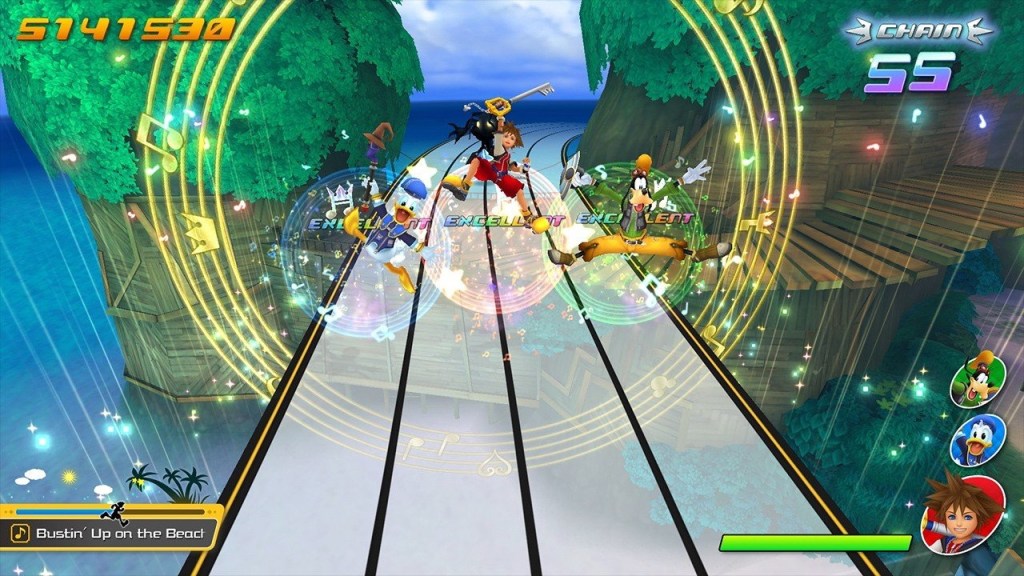
The track selection is pretty good as each game I feel gets the necessary attention they each deserve. Until you get to the tracks picked for Kingdom Hearts III.
Each song in the game uses its original synthesized version (at least if it had one). From what I’ve heard, they sued these original synthesized versions because they were easier to make the notes to have the player to time their actions to, which is pretty stupid in my opinion. They should’ve at least included the option to play the orchestral versions, or even just include them in the music box at least. Kingdom Hearts III by far feels like it’s been cheated the most in this game, with only a few select songs from the game, and they all feature music video-like levels exclusively as they play cutscenes ripped straight from the game. There were so many more songs they could’ve pulled from, but they didn’t. Although, the game was said to have been being made in conjunction with Kingdom Hearts III’s development, so that may have been the reason. But they still could’ve added the songs later via a free update or even worse: DLC. But they’ve stated on multiple occasions that there won’t be DLC or any free updates. So that’s pretty disappointing.
The story mode in this game is almost non-existent, as all it does is recap each game in the series. So in a way, this is a good game if you’re looking to join into the series as it’s second saga begins (although I would highly advise against that) since this game does do a good job at summarizing and recapping everything that’s transpired in the series. The ending is where the actual story comes in, but I can’t talk about it because I don’t want to spoil this game or the ending of Kingdom Hearts III or it’s Re:Mind DLC. But just know, it does literally nothing. All it does it state things we already know from Kingdom Hearts III. Only notable thing about this is that Riku’s voice seems to sound less like a robot than he did in Kingdom Hears III.
There’s also Online mode. If you’re interested in playing this game with others, than I would surprisingly recommend the Switch version of the game. While the PS4 and Xbox version look good, that doesn’t matter at all since this game uses PS2 models. It even turns Sora and Kairi’s appearance in Kingdom Hearts III into PS2 models. So no, graphical capabilities are not a reason at all to buy it on one console over others. The game also runs at the same framerate on all consoles, being at 60fps (even when the Switch is in handheld mode). I’d say that the Switch version is definitive due o the console’s Joy-Con’s being almost perfect for Co-Op play. The game also supports its own exclusive mode known as “Free For All” which allows up to eight players to battle each other in a free-for-all battle via the systems Local Communications.
But this game isn’t really necessary to play if you’re a fan of the series who’s wondering if there’s any extra story it adds on. I don’t really see rhythm game fans getting much out of this game unless they actually enjoy the music of the Kingdom Hearts series. I also don’t see Kingdom Hearts fans getting much out of this game unless they’re fans of rhythm games. Though as a fan of both, I personally had a fun time with this game. And I had even more fun when playing this game with friends, even some friends who aren’t big into the Kingdom Hearts series.
The Timeline
This part shouldn’t be too long. All I’m going to do is list out the basic timeline of the series, which details when each game takes place.
Kingdom Hearts Union X – Kingdom Hearts X Back Cover
Kingdom Hearts Dark Road
Kingdom Hearts Birth By Sleep
Kingdom Hearts – Kingdom Hearts 0.2 Birth By Sleep: A Fragmentary Passage
Kingdom Hearts: Chain of Memories – Kingdom Hearts 358/2 Days
Kingdom Hearts II
Kingdom Hearts Re:Coded
Kingdom Hearts 3D Dream Drop Distance
Kingdom Hearts III
Kingdom Hearts III Re:Mind
Kingdom Hearts: Melody of Memory
In Retrospect…
Looking back at this series, I think that while a lot of these games are undeniably good games, I think a lot of people’s love for this franchise, including mine, boils down to nostalgia. The series has had its hiccups with things like the DS games and Kingdom hearts III’s story, but at least we can hope that they learn from this and try not to make the same mistakes in the future. By far their worst mistake though was the Integrum Masterpiece Collection for Nintendo Switch though. Yeah, the Kingdom Hearts series was brought over to Switch not too long ago via a Cloud version. Don’t but this collection. Even if a Switch is all you have, this is by far the worst way to experience just any game in general. I won’t explain why this is disgusting, just play the free demo yourself if you want to or look up a forum discussion. But this series was very magical in general. I’d say the definitive game in the series to start with is in fact the Final Mix version of the original Kingdom Hearts. It’s the most accessible version of the game and its by far the least confusing entry in the series to jump into. I’d say the definitive experience is to play Kingdom Hearts, watch the cutscenes of Chain of Memories, play Kingdom Hearts II, skip 358/2 Days, skip Re:Coded, play Birth By Sleep, watch a plot summary of the mobile games, play Dream Drop Distance, play A Fragmentary Passage unless you’ve already played Kingdom Hearts III, play Kingdom Hearts III, watch the cutscenes of Re:Mind on YouTube unless you want a challenging experience, and watch the cutscenes of Melody of Memory if the demo didn’t interest you. It’s easy to see where the series started to become the subject of meme culture, but that doesn’t mean its an inherently bad or confusing series at all. At the end of the day, it’s just like any other franchise.
Although we do get a lot of funny lines such as Donald Duck shouting “Sora, it’s Sephiroth!” as an example.
But overall: a pretty great and enjoyable frnahcise. Let’s just hope Tetsuya Nomura doesn’t turn this franchise into Final Fantasy Versus XIII or turn Final Fantasy VII into Kingdom Hearts. Because that would doom the human species. I guess I should also say that the day this will be posted will be on the first game’s 20th anniversary: March 28th, 2002 and that it will be posted at 7:13 a.m.
Kingdom Hearts was reviewed on PlayStation 2 and PlayStation 4.
Kingdom Hearts: Chain of Memories/Re:Chain was reviewed on GameBoy Advance/PlayStation4.
Kingdom Hearts II was reviewed on PlayStation 2 and PlayStation4.
Kingdom Hearts 35/2 Days was reviewed on Nintendo DS and PlayStation 4.
Kingdom Hearts: Birth By Sleep was reviewed on PlayStation 4.
Kingdom Hearts Re:Coded was reviewed on Nintendo DS and PlayStation 4.
Kingdom Hearts Dream Drop Distance was reviewed on Nintendo 3Ds and PlayStation 4.
Kingdom Hearts Mobile Games were reviewed on Mobile.
Kingdom Hearts 0.2 Birth By Sleep: A Fragmentary Passage was reviewed on PlayStation 4.
Kingdom Hearts III was reviewed on PlayStation 4 and Xbox One.
Kingdom Hearts Melody of Memory was reviewed on Nintendo Switch and PlayStation 4.
Written from March 7th to March 27th
 The Squeeble Site